This P6 Science SA2 paper from Catholic High (2021) covers plants, materials, animals and life cycles, heat and temperature, electrical systems and the human body across 40 questions worth 100 marks. Practise Science the way it's tested at P6 level in Singapore, with step-by-step answers on LearnBuddy.
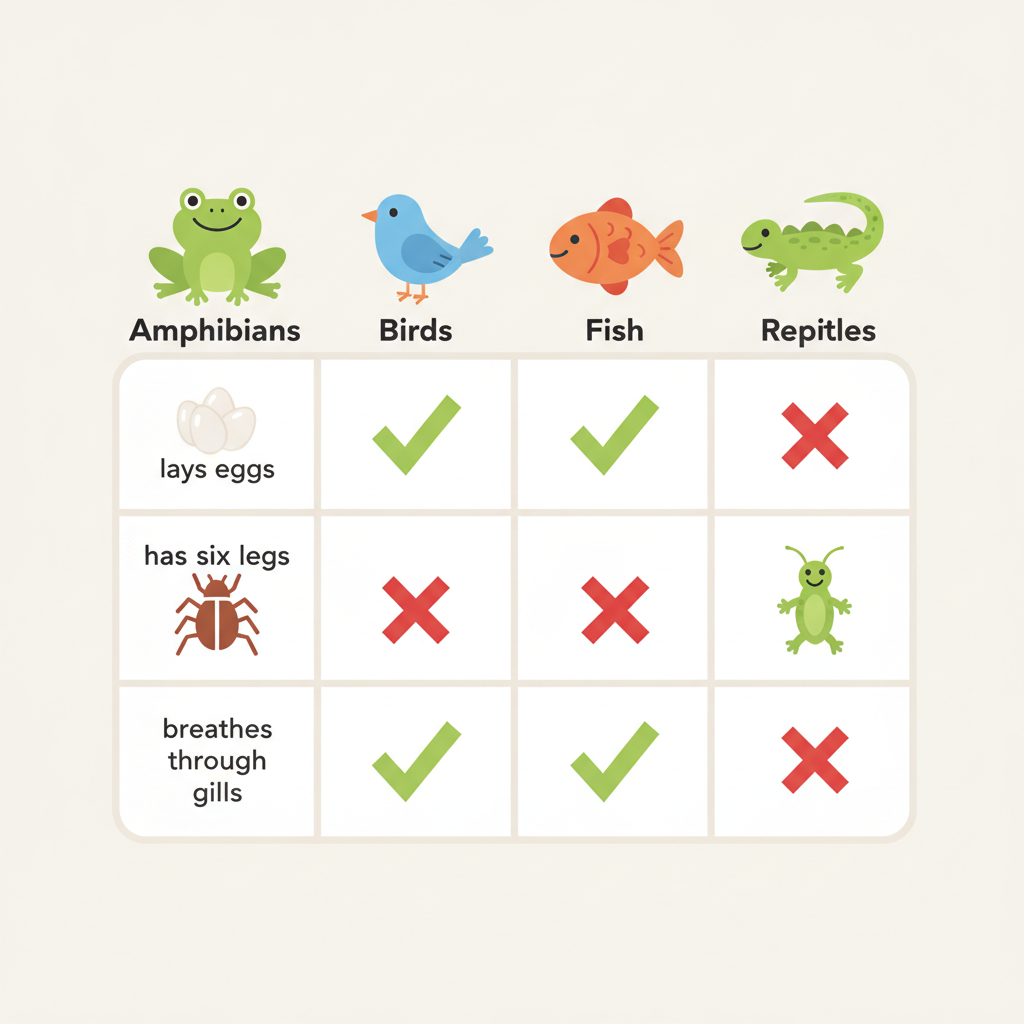
Table with characteristic rows (lays eggs, has six legs, breathes through gills) and columns Amphibians, Birds, Fish, Reptiles. Amphibians: yes/no/yes. Birds: yes/no/no. Fish: yes/no/yes. Reptiles: no/yes/no.
The table below shows the different animal groups and their characteristics. Which animal groups are not classified correctly?
Q2MCQ2 marks
Which of the following is/are not found in the small intestine during digestion?
A solid waste
B digested food
C digestive juices
D undigested food
Q3MCQ2 marks🖼 Visual
Study the diagram below. Which of the following represents E and F?
Q4MCQ2 marks
In what ways are the plant transport system and human circulatory system similar?
A Both transport food and water.
B Both have tubes to transport substances.
C Both transport oxygen and carbon dioxide.
D Both need an organ to pump the substances to different parts.
Q5MCQ2 marks🖼 Visual
The diagram below shows the direction of blood flowing in some parts of the body. The same amount of blood was taken from A, B, C and D. Which graph shows the correct comparison of the amount of carbon dioxide in the blood samples?
Q6MCQ2 marks🖼 Visual
May wanted to conduct an experiment to find out if plants take in water through their roots. Which pair of set-ups should she prepare to conduct a fair test?
Q7MCQ2 marks🖼 Visual
Joanne put a plant into a beaker of water in which some red ink was added. A few hours later, she observed that the flowers turned from white to red. Which of the following explains her observation?
Q8MCQ2 marks🖼 Visual
A group of scientists wanted to produce purple leaves instead of green leaves. Which part of the leaf cell should the scientists change?
Q9MCQ2 marks🖼 Visual
The table below shows the length of two stages in the life cycle of a mosquito and a cockroach. At which stage of the life cycle would the insects be on the 12th day after the eggs have hatched?
Q10MCQ2 marks🖼 Visual
Darius observed three flowers, X, Y and Z. Which flower(s) would develop into a fruit?
Q11MCQ2 marks🖼 Visual
The diagram below shows the reproductive systems of a human and a plant. Which statement(s) is/are correct?
A Fertilisation occurs at parts E and X.
B Parts F and Y store reproductive cells.
C The fertilised egg will develop in parts G and Z.
Q12MCQ2 marks
Plant H bears flowers that are bright yellow and give off a sweet smell. What can we conclude about plant H?
A The fruits are sweet-smelling.
B The seeds are dispersed by animals.
C The flowers are pollinated by insects.
Q13MCQ2 marks🖼 Visual
Phyllis wanted to find out if the different times of the day affect the amount of carbon dioxide water plants produced. She prepared the set-up as shown in the diagram below. She placed the set-up near the window and added a few drops of liquid U to the water. Liquid U changed colour as shown in the table below. What colour would the water with liquid U be at midday and at midnight?
Q14MCQ2 marks🖼 Visual
The diagram below shows a well-watered plant placed next to an open window. The plant has leaves that are green in the centre and white around the edges. The white areas of the leaves do not produce oxygen when exposed to sunlight. Which two areas of the leaves lack only one condition needed for photosynthesis to take place?
Q15MCQ2 marks🖼 Visual
Study the diagram below. Which materials should be chosen to make helmets and boots for firefighters?
Q16MCQ2 marks🖼 Visual
The statements below describe the properties of a substance.
• At 15°C, it has a definite volume and shape.
• At 44°C, it has a definite volume but no definite shape.
• At 125°C, it can be compressed.
Which substance, P, Q, R or S, best represents the substance described above?
Q17MCQ2 marks🖼 Visual
The mass of a sealed plastic bag of air was measured at the start of an experiment using an electronic balance. The bag was then put under the sun for four hours before it was placed on the balance to be measured again. Which statement(s) about the set-up at the end of the experiment is/are correct?
A The air in the plastic bag expanded.
B The mass of air in the plastic bag increased.
C The volume of air in the plastic bag increased.
D The reading on the electronic balance remained the same.
Q18MCQ2 marks🖼 Visual
Study the diagram below. Rashid can see the stool in the presence of light. Which of the following correctly shows the path of light that makes it possible for Rashid to see the stool?
Q19MCQ2 marks🖼 Visual
Ravi conducted an experiment using four set-ups with beakers each containing an equal volume of water at the start of the experiment. At the end of the experiment, he recorded his results as shown below. Which two set-ups support the hypothesis, 'The greater the temperature of surroundings, the lesser the volume of water left in the container.'?
Q20MCQ2 marks🖼 Visual
Su Fen placed an ice cube on material X in set-up A and a similar ice cube on material Y in set-up B. Both materials X and Y were at room temperature at the start of the experiment. She recorded the time taken for each ice cube to melt and reach room temperature. The graph below shows the results of her experiment. Su Fen wanted to bring hot food and cold drinks for an outing. She wanted to ensure that the food stayed hot and the drinks remained cold in the containers. Which materials would be more suitable for the containers?
Q21MCQ2 marks🖼 Visual
50 ml of water was poured into two identical cups, X and Y. The two cups of water were weighed on a digital scale and placed in a location at room temperature. After some time, water droplets were observed to form on the lids and the cups. Which of the following correctly shows the mass of the cups after some time?
Q22MCQ2 marks🖼 Visual
Each of the circuits below has an iron rod, a wooden rod and a plastic rod. In which of the above circuits will the bulb light up?
Q23MCQ2 marks🖼 Visual
Tian Meng constructed a circuit with two batteries, three bulbs and two switches. Identical components were used. He closed one of the two switches and found that all three bulbs lit up. Which is not a possible circuit constructed by Tian Meng?
Q24MCQ2 marks🖼 Visual
Seetha set up an experiment as shown below. She pulled the elastic band backwards and upon releasing the band, the pebble shot from A and hit the box off the stand at B. The box then fell from B to C. Which of the following correctly shows how the amount of energy possessed by the pebble and the box change?
Q25MCQ2 marks🖼 Visual
Block Z was moved from a stationary position at point E to point G and beyond as shown below. After carrying out the above action numerous times, it was observed that tiny bits of block Z broke off as it moved along point E to beyond point G. Based on the information above, which statements are correct?
A A force exerted on block Z caused it to move.
B Kinetic energy of block Z increased from points F to G.
C Frictional force caused block Z to undergo wear and tear.
D The gravitational force acting on block Z decreased from points E to F, then increased from points F to G.
Q26MCQ2 marks🖼 Visual
The diagram below shows a girl about to swing the bat to hit a ball. Which of the following are most likely to happen after she hits the ball?
A The ball changes speed.
B The ball changes direction.
C The ball stops immediately.
D The ball decreases in mass.
Q27MCQ2 marks🖼 Visual
Study the set-up below. Pete conducted an experiment with four bar magnets, E, F, G and H, of different sizes. He moved the magnet towards the pins and recorded the greatest distance, d, at which each magnet would attract some pins. His results are shown in the table below. Based on the results above, what can Pete infer from his experiment?
A Only magnet H can attract pins 5 cm away.
B Magnet F has greater magnetic strength than magnet E.
C The greater the size of the magnet, the stronger the magnet.
D Magnet H can attract more pins than magnet G when the pins are placed the same distance away from them.
Q28MCQ2 marks🖼 Visual
Jacelyn conducted an experiment using four springs, A, B, C and D, each of equal length when unstretched. She hung a metal rod Z from two of the springs at an equal distance apart. The results of her experiment are shown below. In another experiment, she hung four equal masses from each of the springs. Which of the following correctly represents how the four springs would be stretched?
Q29Structured4 marks🖼 Visual
An experiment was conducted to find out the effect of sit-ups on the heart rate of Primary 6 pupils. The heart rate of one pupil was measured before and immediately after doing the sit-ups. The results of the experiment are shown in the table below. (a) State the relationship between the average heart rate and the number of sit-ups performed. [1] (b) The pupil rested for 15 minutes before repeating the experiment. Explain why this step is necessary. [1] (c) The pupil observed that his breathing rate also increased when he was doing the sit-ups. Explain why his breathing rate increased. [1] Before doing the sit-ups, the pupil ate a banana. (d) Describe how the digestive system worked with the circulatory system to allow the pupil to perform the sit-ups. [1]
Sign up free to write your answer — AskBuddy AI will mark it instantly and explain where you went wrong.
Abel removed the outer ring of a stem as shown in the diagram below. As a result, the food-carrying tubes in this stem were removed. Give an explanation for each of his observations. (a)(i) Observation: Part Y remained healthy. Explanation: [1] (a)(ii) Observation: Part Z swelled up. Explanation: [1] (b) Complete the diagram below by drawing arrows (→) to show how water is transported in a flowering plant. [1] (Boxes labelled Leaf, Root, Stem, Flower)
Sign up free to write your answer — AskBuddy AI will mark it instantly and explain where you went wrong.
Plant P has many tiny flowers growing on a stalk, protected by a large, red petal-like leaf. (a) State an advantage of having many tiny flowers growing on one stalk instead of one flower. [1] Fruit bats have been observed to feed on the small berry-like fruits of plant P and pass out the seeds in their droppings. (b) State an advantage of this method of dispersal. [1] (c) State what fertilisation means. [1]
Sign up free to write your answer — AskBuddy AI will mark it instantly and explain where you went wrong.
The diagram below shows plant Z. (a) State the part of the flower where the part of plant Z developed from. [1] (Part of plant Z: pod, bean — Part of flower: ___) The diagram below shows the life cycle of plant Z (seed → seedling → adult plant → seed). (b) State all the conditions needed for process A to take place. [1] The diagram below shows the locations of some young plants X after being dispersed away from parent plants X. (c) Identify a characteristic of the fruit of X and explain how it helps in its dispersal. [1]
Sign up free to write your answer — AskBuddy AI will mark it instantly and explain where you went wrong.
Jane wanted to investigate the effect of coloured lights on the rate of photosynthesis. She prepared small discs cut out from leaves of a plant and exposed them to blue and red light as shown in the diagram below. After some time, she noticed bubbles appearing on the surfaces of the leaf discs. As the bubbles rose, the leaf discs were pushed up and floated on the water. The time taken for all the leaf discs to float is recorded in the table below. (a) In order for the experiment to be fair, state one other variable that Jane has to keep constant. [1] (b) What can Jane conclude from the results above? [1] (c) Suggest a control set-up to improve her experiment further. You may use a diagram OR describe the control set-up in your answer. [1] Jane set up another experiment as shown in the diagram below. She covered three similar leaves in different types of plastic bags. (d) Complete the bar graph above to show the amount of oxygen produced by leaves P and Q in each plastic bag after several hours. [1]
Sign up free to write your answer — AskBuddy AI will mark it instantly and explain where you went wrong.
Rita wanted to find out which material would be best for reducing the most amount of sound passing through it. She placed an electronic bell inside a box that would ring at regular intervals. She recorded the sound level using a sound sensor placed outside the box as shown below. Next, she lined the insides of the box with different materials and recorded her results. (a) Describe the purpose of using a set-up with no material lining the insides of the box. [1] (b) Suggest how using materials of similar thickness allowed for a fair test. [1] Rita's parents wanted to reduce the sound level that could be heard outside the house when she played the piano in her room. (c) Based on her results in the table, which material is most suitable to line the walls of her room? Give a reason. [1]
Sign up free to write your answer — AskBuddy AI will mark it instantly and explain where you went wrong.
Sofia wanted to conduct an experiment with ice cubes. She took out a container of ice cubes from the freezer and observed that there was 'white mist' appearing above them as shown below. (a) Explain how the 'white mist' was formed above the ice cubes. [2] In winter, substance T is put on the road to make ice melt. Sofia conducted an experiment by putting the same amount of ice cubes in two funnels and adding substance T to the ice cubes in the funnel of set-up B. The ice cubes started to melt. Sofia measured the amount of water in each set-up every ten minutes. Her results are shown below. (b) Based on the graph, what was the effect of substance T on the melting of ice? [1] Sofia said that she was able to conclude the effect of more substance T on the melting of ice. (c) Her results in the graph did not support her conclusion. Suggest what she should do to arrive at her conclusion. [1]
Sign up free to write your answer — AskBuddy AI will mark it instantly and explain where you went wrong.
Imran built a puzzle circuit with identical batteries and bulbs, E, F, G and H. He covered the connections to the bulbs with a card as shown below. The bulbs could be seen through holes in the card. All the bulbs lit up when the circuit was closed but their brightness was different. He then removed one bulb from the circuit each time and observed what happened to the rest of the bulbs. His observations are recorded in the table below. (a) Complete the circuit diagram below to show how the four bulbs could be connected. [2] Imran added a switch to the electric circuit in (a) so that he could turn off all the four bulbs at the same time. (b) Write the letter 'S' in the circuit diagram in (a) to show where the switch could be added. [1] Imran constructed a circuit using identical batteries, bulbs and switches. (c) If only S1 was closed, what would happen to the brightness of B1, B2 and B3 if he added another bulb at the position marked 'X' in the circuit diagram above? Give a reason. [1]
Sign up free to write your answer — AskBuddy AI will mark it instantly and explain where you went wrong.
In an experiment, Jovan placed two identical beakers containing the same amount of water at room temperature on two trays of ice as shown below. (a) In which set-up, X or Y, would the temperature of water drop faster? Explain why. [2] Jovan then placed bottles of tea in a tub of ice cubes as shown below. (b) Using the findings from his experiment, suggest what he could do to cool the bottles of tea more quickly. [1]
Sign up free to write your answer — AskBuddy AI will mark it instantly and explain where you went wrong.
The diagram on the right below shows the top view of a pinball machine. The plunger is pulled back to position P to propel the ball into the play area. The player scores more points if the ball hits the bell on its way into the play area. (a) When the plunger is pulled back to position P and released, the ball hits the bell. Explain, in terms of energy changes, why this is so. [2] The bell is then moved to position R. It is observed that the ball could not hit the bell when the plunger is pulled back to position P. (b) Suggest what could be done to the plunger so that the ball is able to hit the bell at R. Give a reason. [2]
Sign up free to write your answer — AskBuddy AI will mark it instantly and explain where you went wrong.
The diagram below shows how a car, travelling on a road, moves a short distance after the driver steps on the brakes for the car to come to a complete stop. This is called 'braking distance'. Julia conducted an experiment to find out how the type of surface affects the braking distance of a car. She rolled a rubber ball over four different surfaces, A, B, C and D, and recorded the time taken for the ball to come to a stop as shown in the graph below. (a) Based on the graph, on which surface, A, B, C or D, would the braking distance of the car be the shortest if the car travelled at the same speed? Explain why. [2] (b) State two variables that Julia needed to keep constant for the experiment. [2] (c) Suggest how the snow chains help the driver to be safe on the icy road. [1]
Sign up free to write your answer — AskBuddy AI will mark it instantly and explain where you went wrong.
The diagram below shows a circuit breaker which acts as a switch to protect an electric circuit from damage due to a sudden increase in electric current flowing through it. It is connected to an electric circuit at points X and Y. The iron arm is held by a spring to ensure that the metal contacts are not separated. However, the metal contacts will separate when there is too much electric current flowing through the circuit. (a) State a physical property of the iron arm for the circuit breaker to work. [1] (b) Explain how the metal contacts separate when there is too much electric current flowing through to prevent damage to the electric circuit. [2] (c) Explain why the spring is not able to hold the iron arm when the metal contacts separate. [1]
Sign up free to write your answer — AskBuddy AI will mark it instantly and explain where you went wrong.