
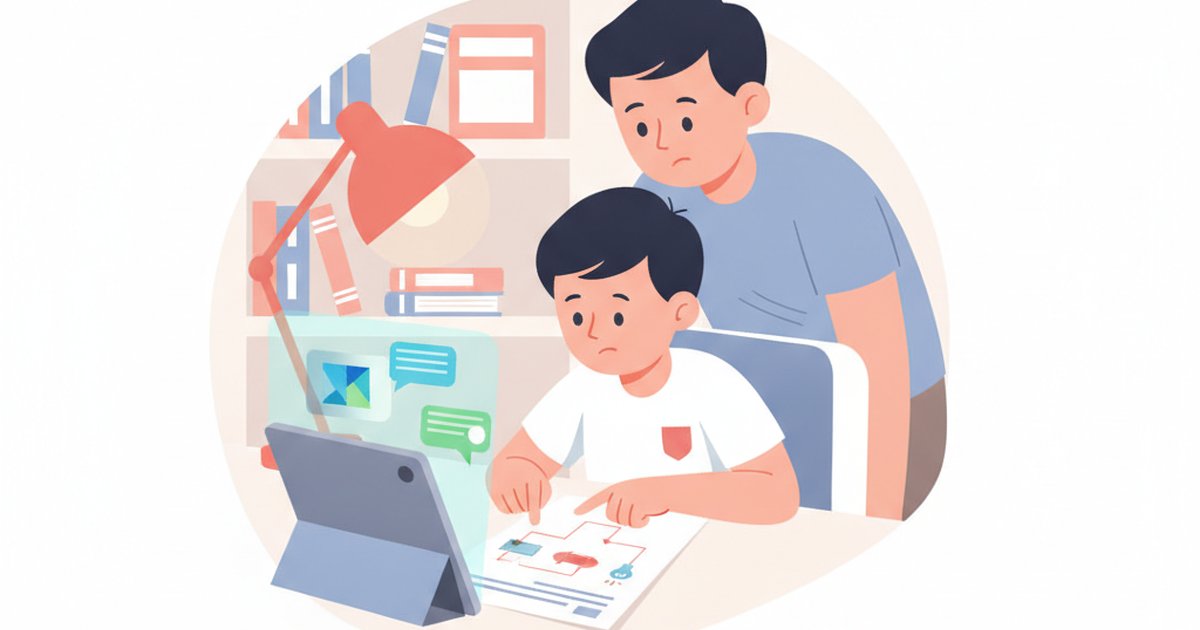
The PSLE Science paper is a diagram exam wearing a chat interface’s worst nightmare. Circuits, ray diagrams, water transport in plants, heat gain and loss — the marks sit in Booklet B, where your child must read a picture and write a precise open-ended answer.
Now try pushing that through a typical AI tutor. This is exactly where the current crop of tools is weakest — and it’s worth knowing why before you pay for another subscription.
Why Do Diagrams Trip Up AI Tutors?
Most Singapore AI tutors are text-first: type a question or upload a screenshot, get an explanation back. Industry observers have noted that many are “essentially ChatGPT wrappers with chat interfaces” — and screenshot-in, paragraph-out works fine for MCQ.
Diagram questions are different. The AI has to correctly read which switch is open, which arrow shows light travelling where, which part of the plant is shaded. AI sometimes gets facts wrong or makes things up — a real concern when kids are still building their foundation. One confidently wrong explanation of why the bulb doesn’t light, and your child has revised the wrong concept. Trust is fragile: one wrong PSLE-style answer and parents rightly walk.
Can My Child Even Ask the Question Properly?
There’s a quieter problem upstream: input. One parent reported her P3 daughter struggled with typing long sentences for synthesis questions — it distracted from learning — and she held off subscribing to Science because of the typing demands. By P6, Science answers demand precise phrasing a child can say in five seconds but takes two minutes to type.
And most tools give them nothing else. Tutorly, for instance, has no drawing canvas, no voice input, no handwriting recognition — it’s a textbox. If your child can’t point at the diagram and ask “why does this arrow bend here?”, the tool is answering a different question from the one in their head.
Who Actually Marks the Open-Ended Answer?
Marking is the burden parents hate most — Science open-ended answers are extremely time-consuming because every line has to be read. So who checks your child’s written answer?
Geniebook’s honest answer is: humans. Real MOE-qualified teachers mark open-ended questions, with a 3-day turnaround. Pure AI chat is instant — but research warns that current AI tutoring is often reactive, handing out direct answers without pedagogical structure. A December 2024 study went further, warning of “metacognitive laziness” from over-reliance. The hopeful part: research also showed a GPT tutor prompted to support rather than replace learning largely avoided those negative retention effects. The design of the tool matters more than the label “AI.”
What Should You Do Instead?
A practical sequence:
- Start with the free option. MOE’s Student Learning Space is government-built with proper guardrails — but note its ALS personalised paths cover P5–S2 Math and Upper Sec Geography, not P6 Science. Treat it as the spine, not the whole answer.
- Demand multimodal input. The diagram must go in whole — image upload plus a drawing canvas your child can annotate, ideally with voice. This is where a tool like LearnBuddy is built differently: your child circles the resistor, asks the question aloud, and the AI responds to that diagram.
- Insist on guided mode, not answer mode. The tool should teach your child how to find it, not hand over the sentence to copy.
- Keep a human check on marking. Cross-reference against past-paper answer schemes, and sanity-check tool experiences on KiasuParents before subscribing.
The Bottom Line
For P6 Science, a text-only AI tutor is solving the easy half of the exam. Diagrams need eyes, a canvas, and a voice — and marking needs either a human or an AI honest enough to guide instead of guess. Test any tool on a real Booklet B diagram question during the free trial. If your child can’t ask it the way they’d ask you at the dinner table, keep looking.