This P3 Science CA2 paper from Maha Bodhi (2025) covers materials, magnets, electrical systems, plants and light and shadows across 12 questions worth 31 marks. Practise Science the way it's tested at P3 level in Singapore, with step-by-step answers on LearnBuddy.
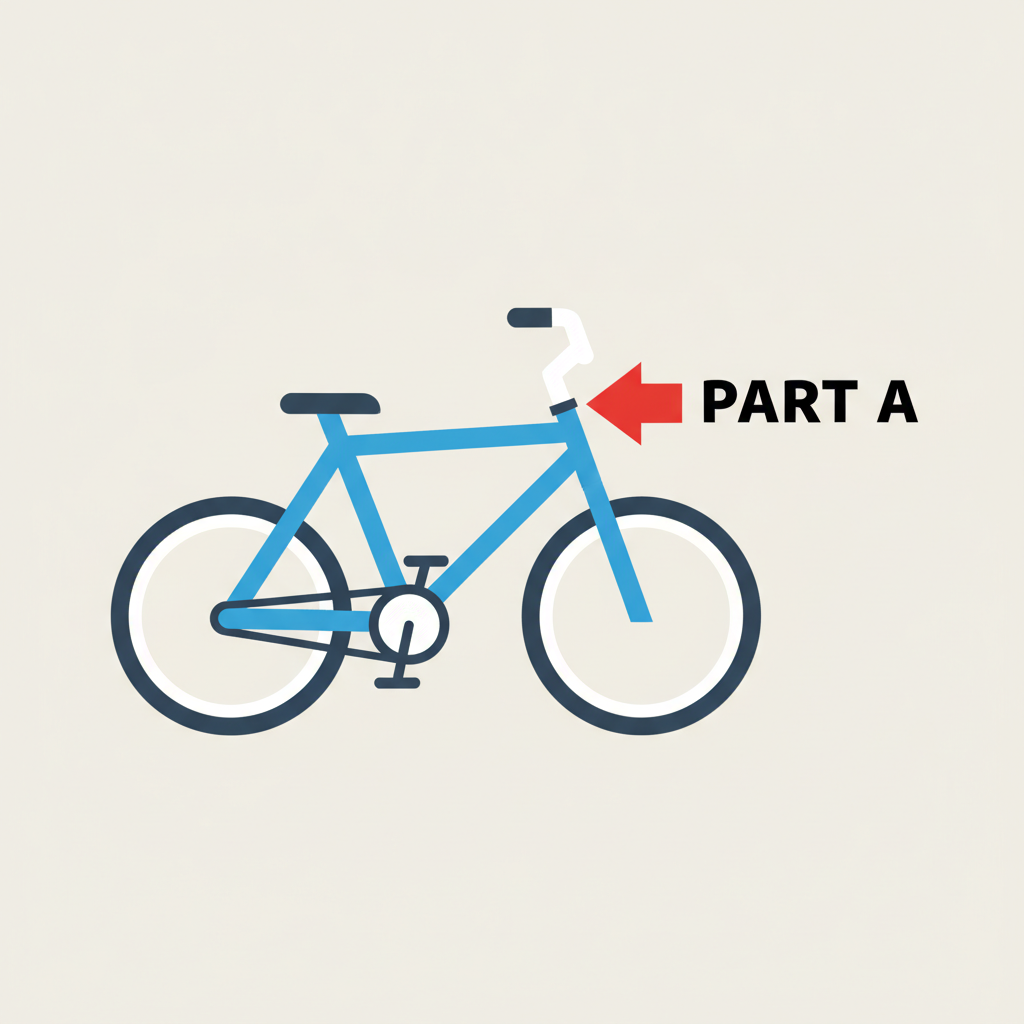
A line drawing of a bicycle with a label arrow pointing to 'part A', which is located at the handlebar/frame area of the bicycle.
Study the bicycle shown below. Which material is most suitable for making part A of the bicycle?
Q2MCQ2 marks
Which of the following properties of material is important when making a table?
Q3MCQ2 marks🖼 Visual
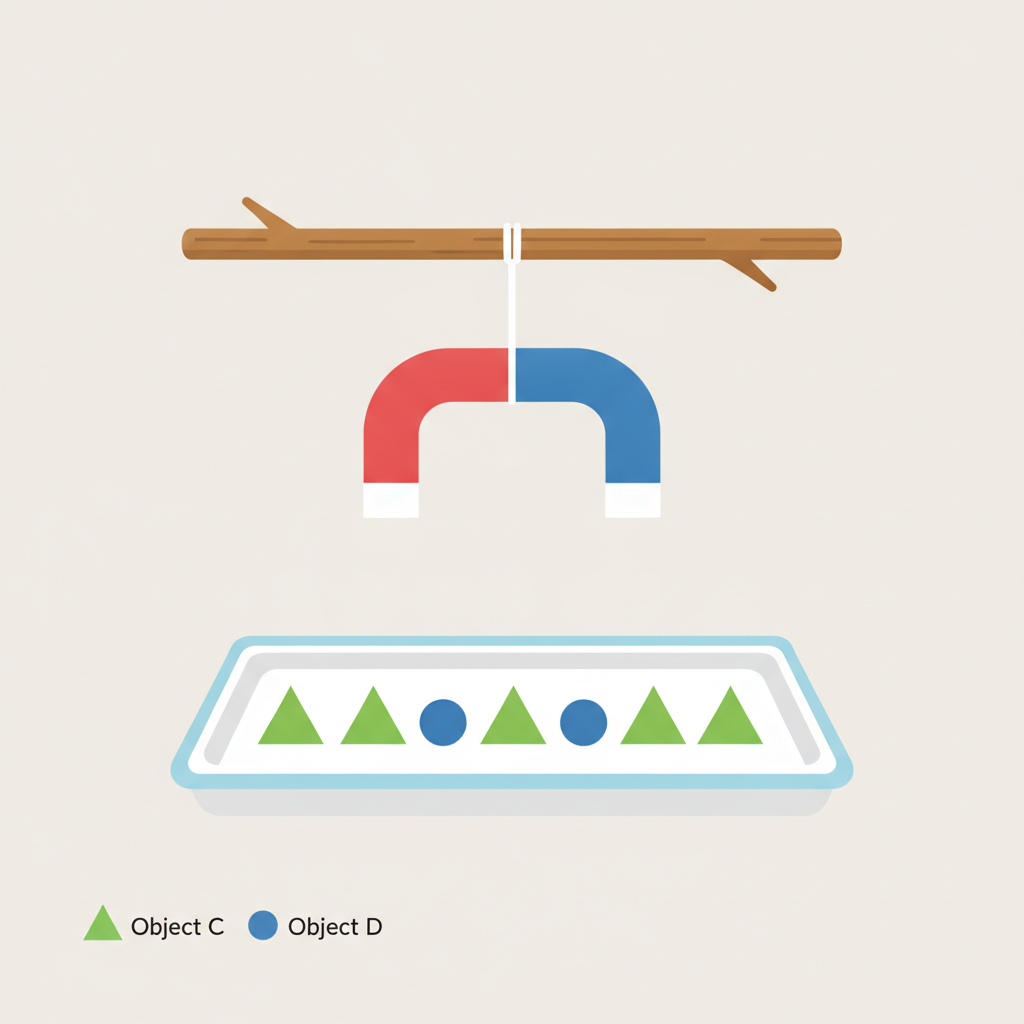
A magnet is tied with a string to a horizontal stick. The magnet hangs above a tray containing alternating triangular objects (object C) and circular objects (object D). A key shows triangles represent object C and circles represent object D.
Lily tied a magnet to a stick as shown below. When she placed the magnet above object C and object D, the magnet only picked up object C. Which of the following could object C and object D be made of?
Q4MCQ2 marks🖼 Visual
A circular basin of water viewed from above. A piece of styrofoam floats on the water with a bar magnet taped on top of it.
A magnet is taped onto a piece of styrofoam and placed into a basin of water. It is then spun until it comes to rest. In which direction does the floating magnet come to rest in?
Q5MCQ2 marks🖼 Visual
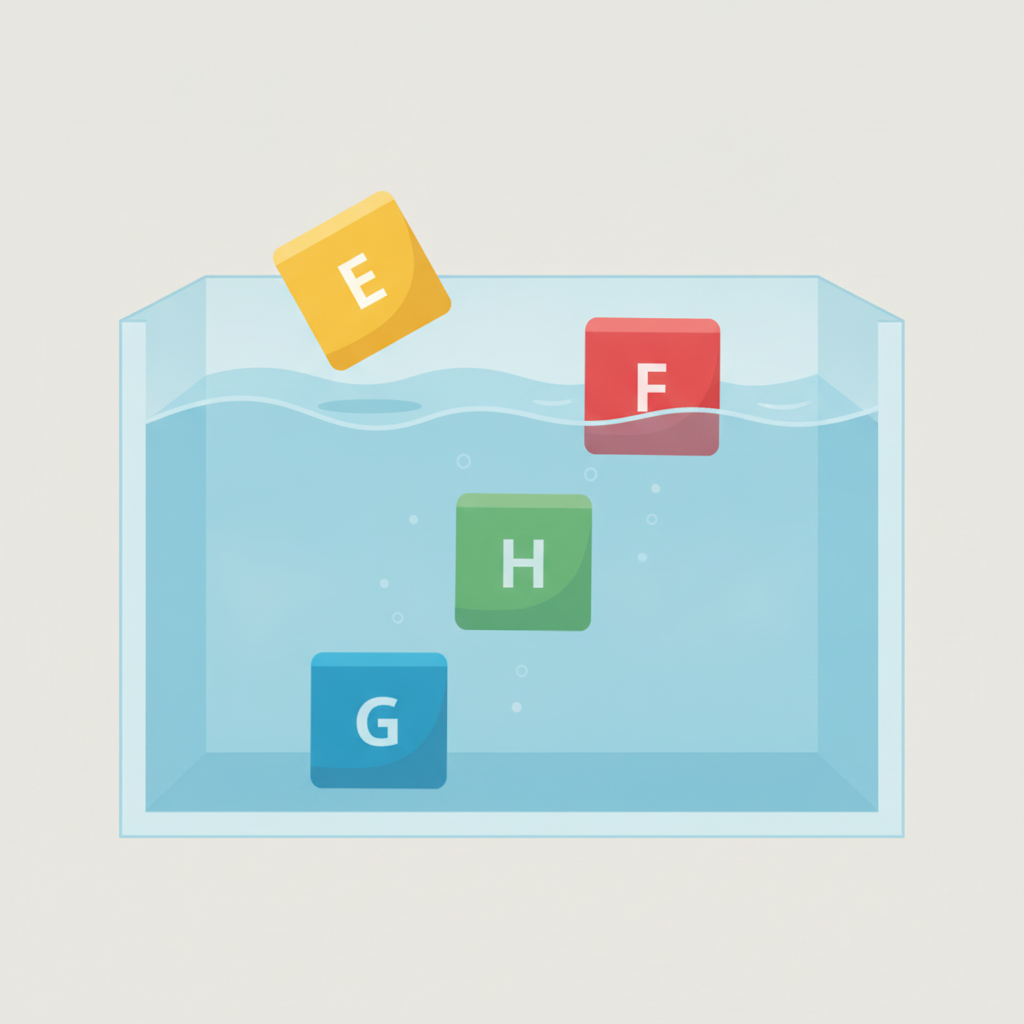
A tank of water shown in cross-section. Cube E floats above the water surface, cube F floats just at the water surface, cube H is suspended in the middle of the water, and cube G rests at the bottom of the tank.
4 similar cubes made of different materials, E, F, G and H, are placed in a tank of water. The diagram below shows the cubes in the tank. Alex's plastic plants will float in water. He wants to attach the plastic plants to one of the cubes so that the plants will sink to the bottom of the tank. Which cube should Alex use to attach the plants so that it will sink?
Q6MCQ2 marks🖼 Visual
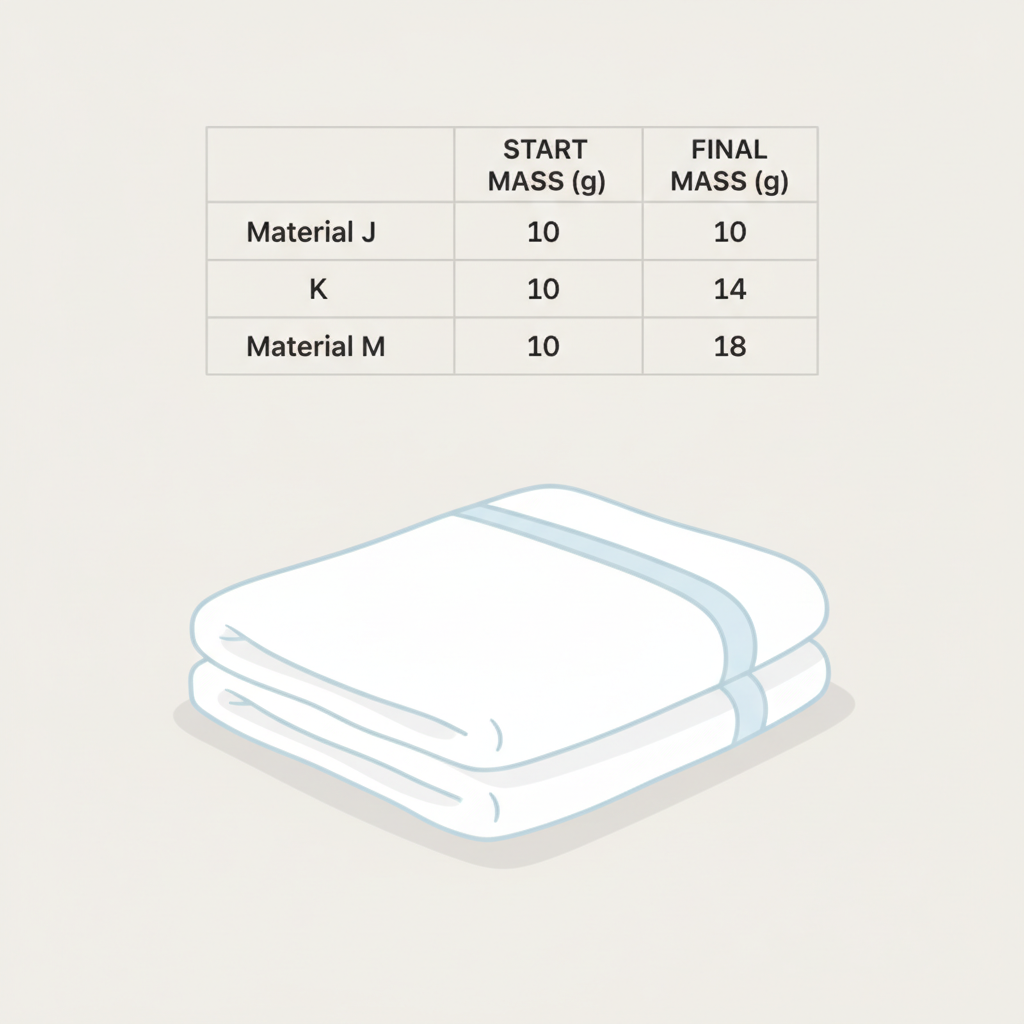
A table showing four materials and their masses. Material J: 10g at start, 16g after 15 minutes. Material K: 10g at start, 10g after. Material L: 10g at start, 14g after. Material M: 10g at start, 18g after. Below the table is a drawing of a folded bath towel.
Four materials, J, K, L and M of similar sizes and thickness were weighed at the start of an experiment. They were then put into four bowls containing same amount of water. After 15 minutes, each material was weighed and the results were recorded on the table below. Mrs Lim wants to use one of the materials to make a bath towel shown below. Which material is most suitable to make a bath towel?
Q7MCQ2 marks🖼 Visual
A toy car, made of steel, was released at point N of a wooden plank as shown below. As the car travels down the plank, the time taken for it to move from point N to point P was taken. The experiment was then repeated with object X placed under the plank. The set-ups for both experiments are as shown below. The table below shows the time taken for the toy car to travel from N to P. Based on the information above, what was object X likely to be?
Q8MCQ2 marks🖼 Visual
Jimmy wanted to find out which of three metal bars, AB, CD and EF are magnets. He hung each bar from a string and brought them near to each other. His results are shown below. Which one of the following describes each metal bar correctly?
Q9Structured4 marks🖼 Visual
Study the flowchart on materials. (a) Based on the flowchart, state all the properties of material A. (b)(i) Janet conducted an experiment to test the strength of three different materials, E, F and G. The materials are of the same thickness and length. Weights were added one by one to the material. The number of weights added before it broke is shown in the graph below. Based on the graph above, arrange the materials, E, F and G, based on their strength from the strongest to the weakest. (b)(ii) Janet wanted a band to tie up her book as shown below. Besides not breaking easily, what is another property that the band must have?
Sign up free to write your answer — AskBuddy AI will mark it instantly and explain where you went wrong.
Jenny blows air into a balloon made of material H. (a)(i) State a suitable material for material H. (a)(ii) What happens to the size of the balloon after air was blown in? (b) Jenny then used a torchlight and shone a light through material H as shown below. She then repeated the experiment using another material and made the following observations. Material H: A blur spot of light was seen on the screen. Material J: No light was seen on the screen. Based on her observations above, what can she conclude about materials H and J?
Sign up free to write your answer — AskBuddy AI will mark it instantly and explain where you went wrong.
Irene wants to make an iron nail into a magnet by the 'stroke' method. The arrows represent the direction of stroking. (a)(i) Tick (✓) the diagram which shows the correct way of using the 'stroke' method to make an iron nail into a magnet. (a)(ii) Name another method that Irene can use to make the iron nail into a magnet. (b)(i) Irene used the magnetised iron nail to attract some pins. She repeated the steps a few times and recorded her observation in the table below. Based on her results, what is the likely value of K? (b)(ii) Irene decided to make an aluminium nail into a magnet by the 'stroke' method. Explain why the nail could not attract or repel any steel pins.
Sign up free to write your answer — AskBuddy AI will mark it instantly and explain where you went wrong.
Sean wanted to find out how the number of coils of wire around an iron nail affects the strength of an electromagnet using the set up shown below. He recorded his observations in the table below. (a) State what would happen to the steel needles that were attracted to the electromagnet when the battery is removed. (b) Based on the results, how does increasing the number of coils of wire around the iron nail affect the strength of the electromagnet? (c) Sean added another battery to his set up with 30 coils of wire around his iron nail as shown in the diagram below. Would Sean observe more, fewer or similar number of pins attracted by the electromagnet? Explain your answer.
Sign up free to write your answer — AskBuddy AI will mark it instantly and explain where you went wrong.