
If your household speaks English at home, P5 Chinese is where the wheels come off. The vocabulary jumps, 作文 gets longer, and 口试 stops being “read this paragraph nicely” and starts demanding opinions.
Here’s the trap: most AI tutors can’t help. Geniebook’s Chinese was built on the old syllabus, not 欢乐伙伴 — so the practice your child does doesn’t match what the teacher taught on Monday. You end up paying for confusion.
This guide breaks Textbook 5 into practice blocks you can actually run at home.
Start With the Unit, Not the Whole Book
Open your child’s 课本 and work one 单元 at a time. For each unit, three passes:
- 课文 comprehension — can she retell the passage in her own words, not recite it?
- 词语 in use — not “define 犹豫”, but “use 犹豫 in a sentence about your CCA.”
- 句型 transfer — take the unit’s sentence pattern and force it into a new context.
That third pass is the one tuition centres skip and exams reward. A good AI tutor should generate fresh sentences on demand — infinitely, at 11pm, without you marking anything.
Drill 听写 With Voice, Not a Keyboard
Here’s a problem nobody markets around: primary kids can’t type Chinese. Hanyu Pinyin input on a laptop is a skill in itself, and your P5 shouldn’t be learning IME shortcuts when she should be learning characters.
One parent flagged exactly this — her P3 struggled typing long sentences and she held off subscribing entirely.
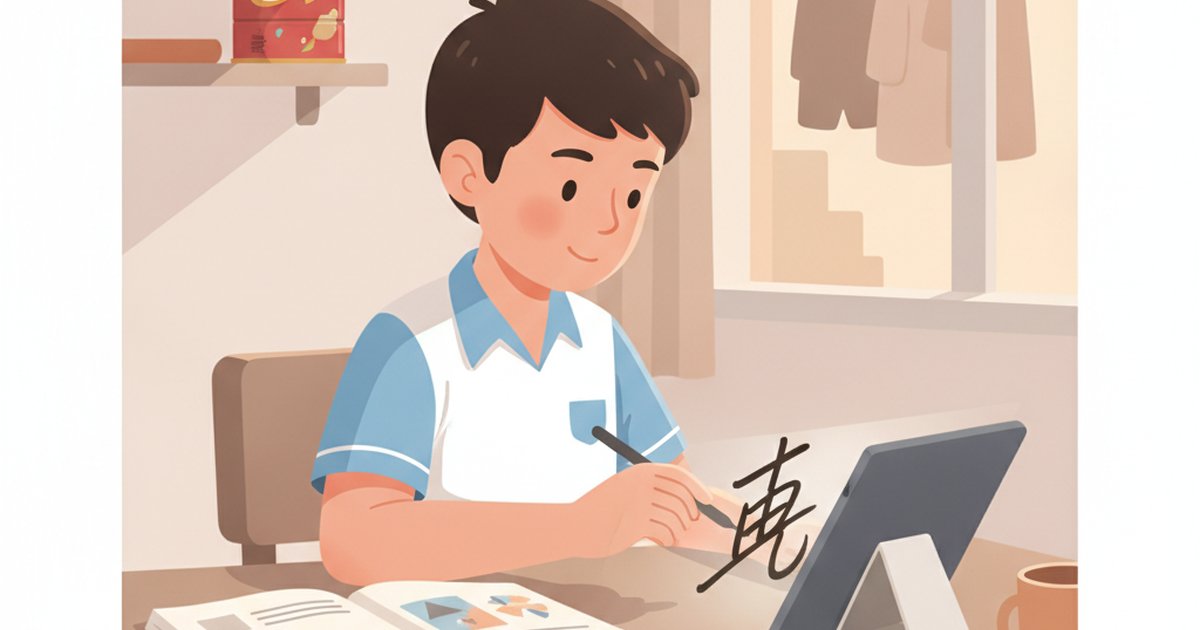
So for 听写: the tutor reads the 词语 aloud, your child writes on a canvas with a finger or stylus, and handwriting recognition checks the strokes. That’s the real test. Typing 听写 defeats the purpose — the computer supplies the character.
Rehearse 口试 Out Loud, Every Week
P5 oral has two halves — 朗读 and 会话 — and 会话 is where English-speaking kids bleed marks. They know the answer in English and freeze translating it.
Weekly routine, 10 minutes:
- 朗读: read the passage aloud, get pronunciation and 停顿 flagged
- 会话: answer one opinion question — “你觉得同学之间应该怎么互相帮助?”
- Follow-up: the tutor pushes back with a second question, forcing a longer answer
Voice-native practice matters here. A chat window can’t hear that your child said 四 when she meant 十.
Turn 课文 Into 作文 Material
P5 composition rewards recycling. The 好词好句 in each unit are exam-ready phrases — but only if your child has used them three or four times before the paper.
Practice loop per unit:
- Pull 5 phrases from the 课文
- Write one paragraph using three of them
- Get feedback on 用词 and 连接词, then rewrite the same paragraph
The rewrite is non-negotiable. Marking that arrives a week later — the way it does with assessment books — teaches nothing, because your child has forgotten what she was thinking.
Pick a Tool That’s Actually on 欢乐伙伴
Before you pay anyone S$49–S$154 a month, check three things:
- Syllabus match: does it name 欢乐伙伴, or just say “MOE-aligned”?
- Handwriting + voice: or is it a text box?
- No annual lock-in: Geniebook runs on a one-year subscription with a 30-day refund window and auto-renewal. Parents on KiasuParents have documented what happens when you need out early.
MOE’s own SLS is free and worth using, but its personalised learning paths cover P5–S2 Math — not Chinese. It won’t carry your MT revision.
The Bottom Line
One 单元 a week. Comprehension, 词语, 句型 on weekdays; 听写 by handwriting; 口试 out loud on Saturday; one paragraph rewritten twice.
That routine beats a S$400/month centre slot your child sits through tired on a Wednesday evening — as long as the tool is on the right textbook. LearnBuddy covers all subjects P1–JC2 from S$39/month, cancel anytime, with voice and a drawing canvas built for kids who can’t type yet.