
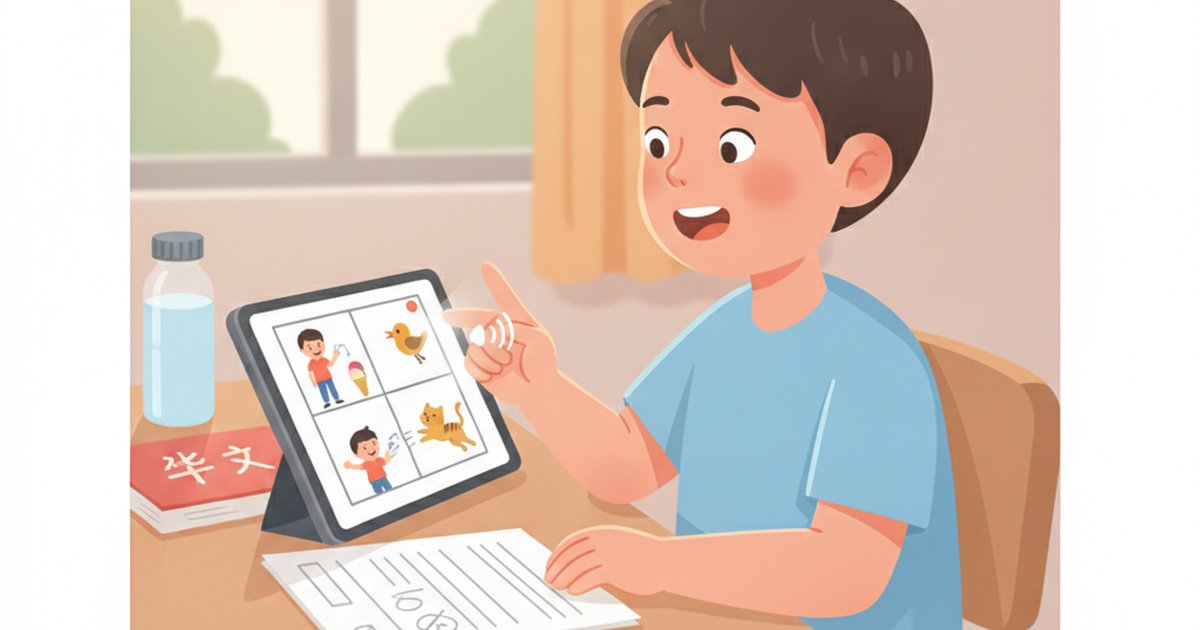
Your P3 child can describe the cartoon perfectly — in English. Ask for it in 华文 and you get three broken sentences and a meltdown. If you’re in an English-speaking household, 看图作文 is where the gap shows most. Here’s a method that uses AI properly — to coach, not to hand over a model essay your kid copies and forgets.
Why 看图作文 Trips P3 Kids
Picture composition isn’t a vocabulary test. It asks the child to sequence — 起因, 经过, 结果 — then narrate with feeling, all in a language they barely speak at home. Most AI tools make this worse, not better, because they spit out a polished sample 范文. The child copies it. The skill never lands. Worse, many big platforms run Chinese on the old syllabus, not 欢乐伙伴 — so the phrasing doesn’t even match what the teacher rewards.
Step 1: Describe the Picture Out Loud First
Before any writing, have your child say what’s happening in each panel. Out loud, in Chinese, even if it’s clumsy. A voice-capable AI tutor is the unlock here — your P3 kid thinks far faster than they can type 汉字, and typing kills the momentum. Speaking removes the keyboard wall entirely. The tutor listens and nudges: 然后呢? 他心情怎么样?
Step 2: Build the 四要素 Skeleton
Now structure it. Have the AI ask guiding questions — not write sentences — to fill four slots: 时间地点 (when/where), 人物 (who), 经过 (what happened), 结果 (how it ended). This is the MOE-style scaffold teachers use. The free MOE Student Learning Space does a version of this with its guiding-question role; a good home tutor should do the same, every time, not just hand over a finished paragraph.
Step 3: Make the AI Ask, Not Answer
This is the whole game. Research and parent forums like KiasuParents are full of the same worry: AI that gives answers breeds dependency and “metacognitive laziness.” For 看图作文, set the tutor to Socratic mode — it refuses the model essay and instead asks 你能用一个更好的词吗? when your child writes 很开心 for the fifth time. The child upgrades to 兴高采烈 themselves. That’s the sentence that sticks.
Step 4: Drill the 好词好句, Then Rewrite
Once the skeleton holds, layer in two or three 成语 or vivid phrases that fit this picture — not a generic list. Then the child rewrites the whole piece once, unaided. The AI flags weak verbs and tense-of-feeling gaps. Pair this with regular 听写 and 口试 practice through the same voice tutor and the vocabulary compounds week over week.
Step 5: Let the AI Mark It — So You Don’t Have To
Be honest: you probably can’t mark P3 Chinese composition confidently, and reading every line is exhausting. A tutor that marks structure, word choice, and 错别字 instantly — and shows you a weekly summary of what your child keeps getting wrong — closes the loop tuition centres leave open, where you only find out at exam time.
Choosing a Tool That Does Chinese Right
Run any candidate through three checks: Does it use 欢乐伙伴, not the old syllabus? Does it support voice for kids who can’t type 汉字? Will it coach instead of dumping a 范文? Geniebook bundles Chinese at around S$154/month per subject on an annual lock-in — and its Chinese has been flagged as off-syllabus. Tutorly and Klara sit at S$49/month, text-only. There are now monthly, cancel-anytime options from S$39 covering all subjects with voice and a parent dashboard built in — start a free trial before you pay for anything with a contract.
看图作文 isn’t about a perfect essay this week. It’s about your child building the sentence themselves, in their own clumsy-then-confident 华文 — and an AI that asks the right question is worth ten that just give the answer.