
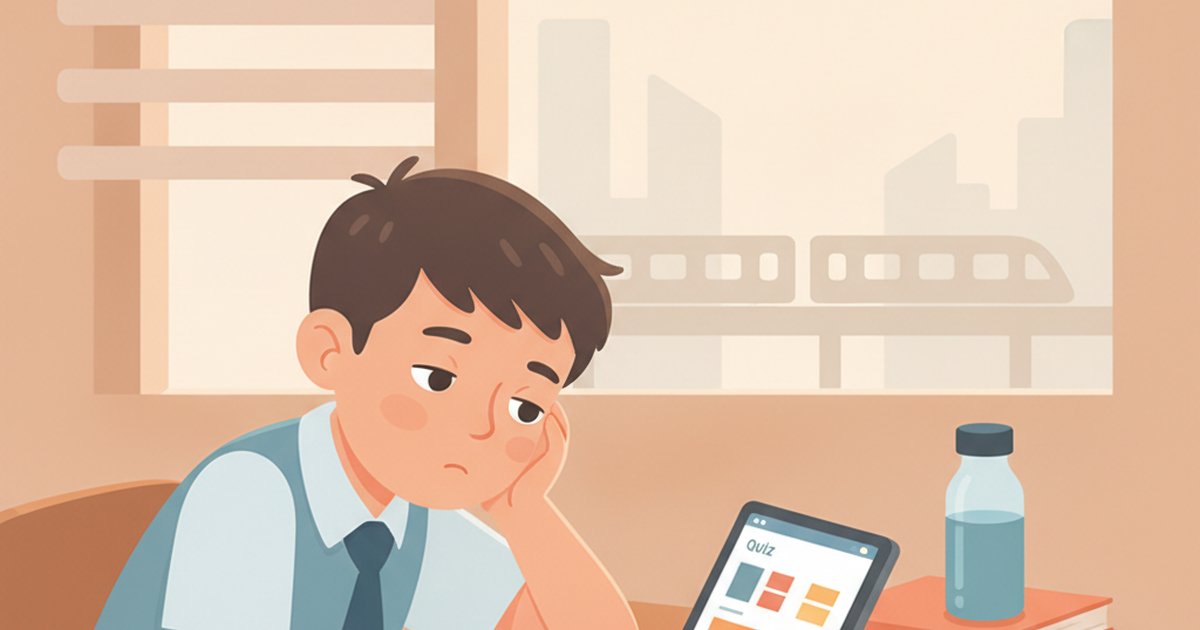
When he was six, he’d count the lift buttons, the tiles on the void deck floor, the seconds between MRT stops. By P3 he was the kid who finished the worksheet first and asked for harder questions. By P5, he was the kid who slid the iPad across the table and asked, flatly, “Just tell me the answer.”
That gap — the part where his brain stopped reaching — happened during the year we spent close to S$5,000 at a tuition centre and another S$154 a month on Geniebook.
This is what we got wrong, and what every Singapore parent paying for tuition right now should check before it’s too late.
The Centre Bought Compliance, Not Curiosity
Twice a week, after school, after CCA, the routine: bag, MRT, centre, two hours of drills, MRT home, dinner, more homework. Maths grade went from a C to a C+. The price tag, between fees, transport, and the workbooks they kept pushing at the counter, crossed S$5,000 in twelve months.
What he stopped doing in that same year: asking why fractions work. Doodling number patterns. Guessing answers and laughing when he was wrong.
Compliance and curiosity look the same on a report card. They are not the same thing.
Geniebook Made It Worse, Quietly
The promise was “AI personalisation.” What we actually paid for was an app that repeats the questions he got wrong. One parent on KiasuParents put it more bluntly than I ever could: the only noticeable AI element is the app repeats wrong questions. Geniebook itself markets the truth — parents pay monthly, hope for the best, and only find out if it’s working when exam results arrive.
By month four, he had stopped opening it. The S$154 was still leaving our account. The yearly lock-in meant we couldn’t stop. The “suspension” we’d been promised at signup turned out to be capped at 60 days a year — system issue, not in the contract, sorry ma’am.
The Hidden Cost: His Brain Stopped Reaching
Recent academic research has been loud on this. Direct-answer AI tutoring hindered retention. A December 2024 study warned of “metacognitive laziness.” The fear every parent has — that the app becomes a shortcut instead of a support — is real, and it shows up first as a missing question. The “why” stops.
That’s what I missed for almost a year. He wasn’t getting worse at math. He was getting better at outsourcing it.
What Actually Brought It Back
We did three things, none of them expensive.
We stopped the centre. Used the saved S$400 a month to buy back unstructured time: library on Saturdays, swimming, an actual nap. The grade dipped half a step and then climbed back — slower, with more understanding behind it.
We made him talk through problems out loud. No typing. Just voice. Whether it was me at the kitchen table or an AI tool with voice and a drawing canvas, the rule was the same: explain the step before you write it. Primary kids think faster than they type; making them type kills the thinking. Make them talk, and the thinking comes back.
We banned “just give me the answer.” Borrowed from MOE’s own SLS LEA tool, which guides students with questions instead of solutions. Whatever tutor or app he used had to do the same — refuse to hand over the answer, and walk him to it instead.
What To Check This Week If You’re Paying For Tuition
Four questions. Be honest with yourself.
- When did your child last ask “why” about something they’re studying, unprompted?
- Are they typing, drilling, and repeating — or actually thinking out loud?
- Does the tutor or app teach the method when stuck, or deliver the answer?
- Are you paying because it’s working, or because stopping feels riskier than continuing?
If three of those answers worry you, the spend isn’t the problem. The shape of the help is.
The Bottom Line
He’s twelve now. He still doesn’t love math the way he did at six — that pure, unsupervised curiosity is hard to fully rebuild. But he asks “why” again. He guesses. He laughs when he’s wrong. That is the part the S$5,000 tuition year almost cost us permanently.
The right tutor — human or AI — should make your child more curious, not less. If yours doesn’t, you have permission to stop paying for it.