
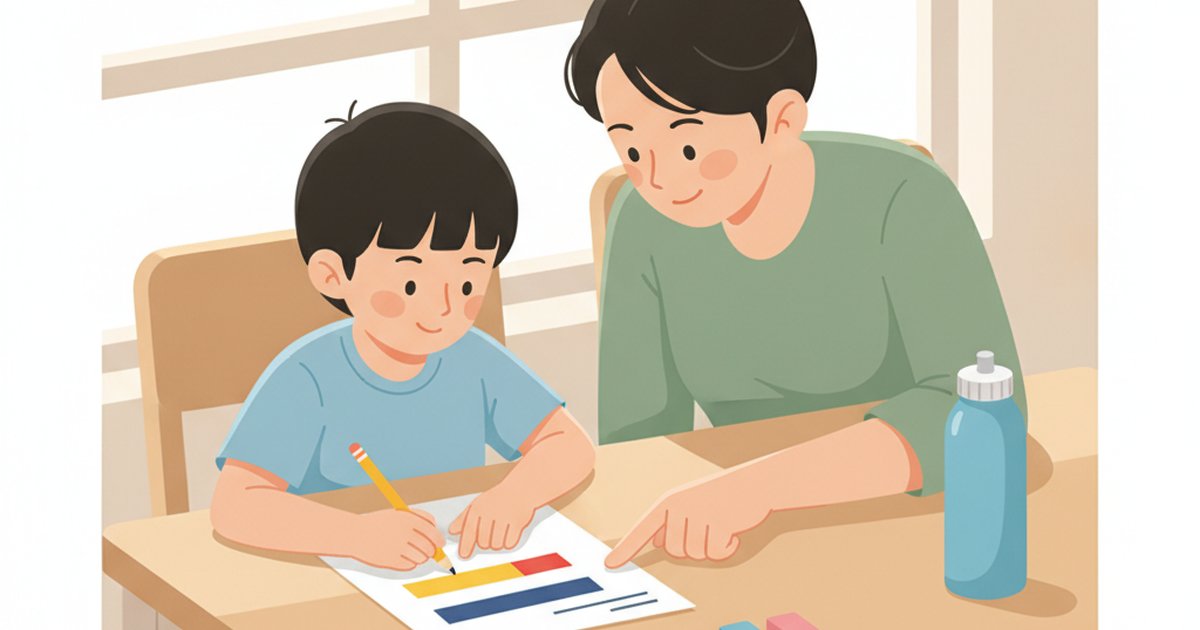
Your child could add and subtract fine in Primary 1. Then Primary 2 arrives, the word problems get longer, and suddenly there’s this thing called a “bar model” — rectangles drawn on the page — and your confident little counter goes quiet.
You’re not imagining it. Bar models are the first genuinely abstract idea in the Singapore maths syllabus, and they trip up a lot of otherwise-capable kids. Here’s what’s actually going on, and how to help without turning homework into a nightly battle.
What a bar model actually is
A bar model is a picture of a number problem. You draw a rectangle to stand for a quantity, then split it or stack it to show the parts and the whole.
If Ali has 8 sweets and gives 3 away, you draw one long bar for 8, mark off 3, and the leftover chunk is the answer. That’s the part-whole model. Later comes the comparison model — two bars side by side to show “5 more than” or “twice as many.”
It looks simple to an adult. To a seven-year-old, it’s the first time a drawing has to represent something instead of just being something. That leap is the whole difficulty.
Why P2 kids stall on it
Three reasons show up again and again:
- They can do the sum but can’t draw it. The maths isn’t the blocker — translating words into a picture is. Kids rush to the number and skip the model entirely.
- They draw the bar wrong. Comparison problems especially: they’ll draw two equal bars for “Sara has 4 more than Tom,” because equal-looking rectangles feel tidier.
- Working can’t be typed or rushed. A bar model is a thinking tool. Kids who are trained to blurt the answer resist slowing down to draw it.
None of this means your child is weak at maths. It means they’re meeting abstraction for the first time, and abstraction needs practice, not pressure.
How to help at home without doing it for them
The trap every parent falls into: you see the struggle, you grab the pencil, you draw the bar, they copy it. They learn nothing except that you’ll rescue them.
Do this instead:
- Read the problem together, then stop. Ask “what do we know?” and “what are we trying to find?” before any drawing.
- Let them draw badly. A wonky bar they made beats a perfect one you made. Fix it by asking questions, not by re-drawing.
- Use real objects first. Line up 8 erasers, physically remove 3. Then draw what you just did. The bar becomes a record of something concrete.
- Praise the model, not the answer. “I like how you showed the two parts” trains the habit you actually want.
MOE’s own free Singapore Student Learning Space has guided-question tools that model this Socratic style — worth a look before you pay for anything.
Why the drawing step matters more than the answer
Here’s the long game. Bar models aren’t a P2 gimmick you outgrow. The same method scales all the way to PSLE, where the hardest problem sums are unsolvable without a clean model. The kid who learned to draw properly at seven has a massive advantage at twelve.
That’s why the answer-first shortcut is so dangerous. Plenty of tools and tutors will just hand your child the solution — but research on AI tutoring is clear that giving answers without pedagogical structure hurts retention, and this shows up most in mathematics. Parents on KiasuParents say the same thing about typing-heavy apps: their lower-primary kids struggle to type long working, so the app does the thinking for them.
A bar model is the opposite of a shortcut. It forces the child to lay out their reasoning before touching a number — which is exactly the skill the syllabus is trying to build.
The bottom line
If your P2 child is stalling on bar models, you’re at a normal, important checkpoint — not a crisis. Slow down. Let them draw. Ask questions instead of supplying answers. Keep it multimodal — objects, then pictures, then numbers — because that’s how the concept actually clicks.
Get this one right and you’re not just clearing a P2 hurdle. You’re laying the foundation the next five years of Singapore maths will stand on.