
Friday morning. The 听写 list is due. You’re an English-speaking parent and you can’t pronounce half the words on it, let alone test her. Your daughter, meanwhile, is one wrong character away from her tenth red mark this term.
Welcome to the most quietly stressful weekly ritual in Singapore primary school.
The good news: this is the single best use case for an AI tutor in 2026 — if you pick one that actually does Chinese properly. Most don’t.
Why Most AI Tutors Fail at 听写
Three reasons. All disqualifying.
1. Wrong syllabus. Major incumbents (yes, including Geniebook) run Chinese on the old MOE syllabus — not 欢乐伙伴, the textbook actually taught in primary schools today. The vocab lists don’t match. The 课文 don’t match. Useless.
2. No handwriting recognition. 听写 is about writing the character correctly — stroke order, structure, no missing dots. A typed Chinese character via pinyin keyboard tells you nothing about whether your child can write it.
3. No real audio. A robotic voice clipping out 一,二,三 isn’t 听写 practice. You need natural Mandarin pronunciation with 词组 read at sensible speed, the way her teacher reads it.
If your AI tool doesn’t have all three of these, it cannot do 听写. Move on.
The Right Way: 4 Drills That Actually Work
1. Audio dictation, written by hand on the tablet
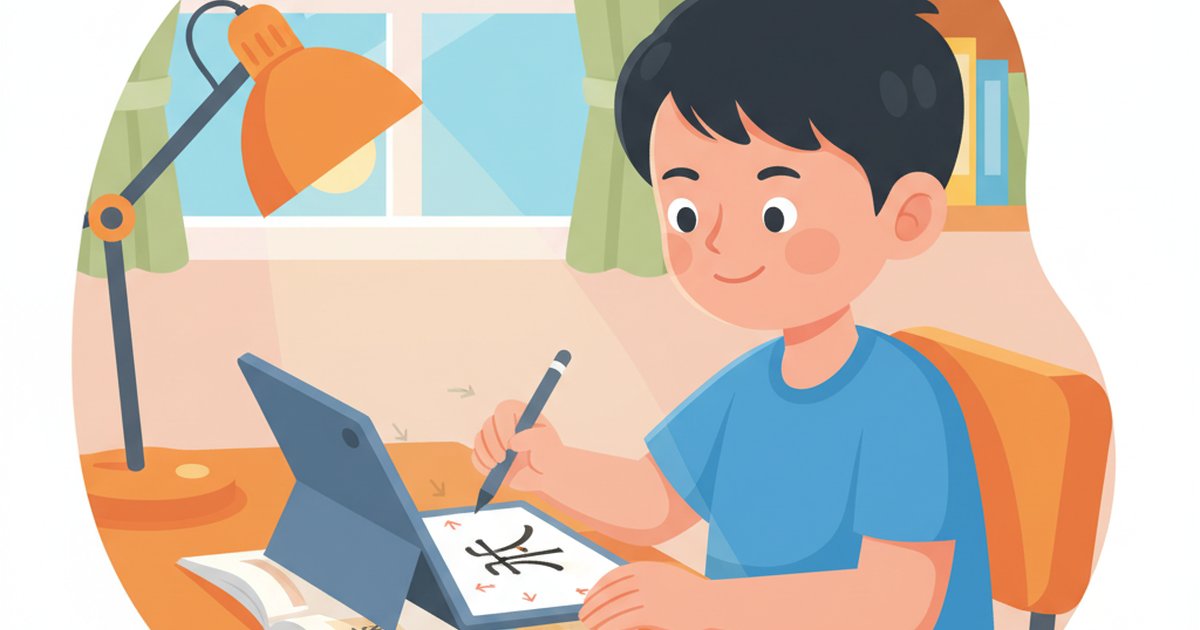
The AI reads the 词组 aloud in clear Mandarin. Your child writes the character on a drawing canvas with a stylus. The AI checks stroke order, stroke count, and shape — not just the final form.
This is the closest digital equivalent to 老师 reading off a list while she writes on paper. It’s also where every typing-only tool collapses.
2. The “explain the radical” drill
Once she gets a character right, ask the AI to ask her: “What’s the radical? What does it usually mean?”
AI: 这个字的部首是什么?
Kid: 三点水
AI: 对,三点水通常和什么有关?
Kid: 水 / 液体
This builds the pattern recognition that turns rote memorisation into actual literacy. Twenty minutes of this beats two hours of mechanical copying.
3. 口试 voice practice
For 口试 — the oral component most parents dread — voice mode is the killer feature. The AI prompts her with a picture (朗读 / 看图说话), she speaks her response in Mandarin, and the AI critiques pronunciation, fluency, and use of 成语.
This is genuinely hard for English-speaking parents to drill at home. AI fixes that.
4. Spot-the-character-mistake
Take a wrong character she wrote earlier (school 听写, workbook, last week’s). Photo it, ask the AI to ask her what’s wrong. “是不是少了一笔?哪里多了一点?”
Self-correction in Chinese is the skill that separates students who plateau at C5 from students who push to A1. Most kids never get drilled on it because parents can’t see the mistake themselves.
A Realistic Weekly Plan
| Day | Drill | Time |
|---|---|---|
| Mon | 10 new 词组 — audio dictation, handwritten | 20 min |
| Wed | Radical + meaning explain-back (5 characters) | 15 min |
| Thu | 口试 picture-talk practice (one prompt) | 15 min |
| Fri (after 听写) | Spot-the-mistake on whatever she got wrong | 15 min |
Total: 65 minutes a week. Less than one tuition session, far more targeted at what actually shows up in school.
What to Look For in the Tool
Before paying:
- 欢乐伙伴 syllabus alignment — ask explicitly. Most tools dodge this.
- Handwriting recognition with stroke-order feedback (not just shape matching)
- Natural Mandarin TTS — Singapore-style if possible, Mainland accent is acceptable, robotic accent is not
- Voice input that handles a P3 child’s Mandarin without choking
- A drawing canvas large enough to write characters comfortably with a stylus
If even one is missing, the tool is built for HSK adults learning Chinese as a second language — not Singapore primary school 华文.
The Bottom Line
Chinese is the subject where Singapore parents most need help and where existing AI tutors most underdeliver. That gap is closing — but only if you pick a tool built specifically for the 欢乐伙伴 syllabus with proper handwriting and voice support.
Get that right, and the Friday 听写 stops being a household crisis. It becomes 65 minutes a week your child runs herself, while you finally drink your kopi in peace.
That alone is worth the subscription.