
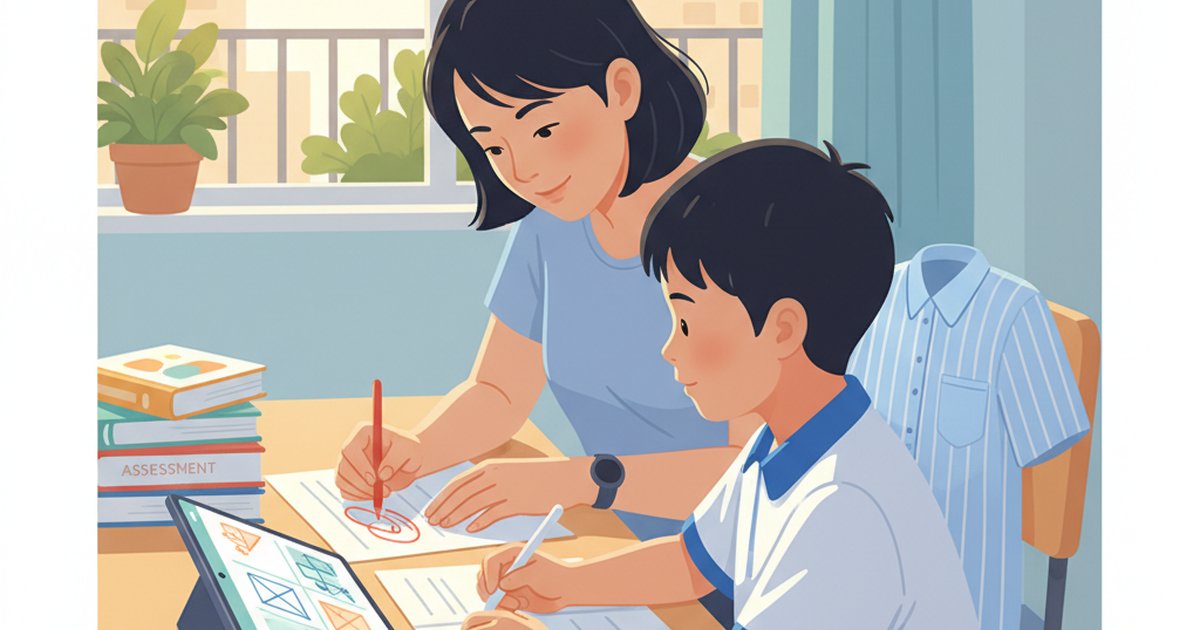
Your P5 daughter shows you the AI’s answer. The final number is right. You nod, she moves on. Three weeks later her teacher circles the same question on a mock paper — wrong method, wrong marks, even though the answer matched. The AI made it up. Confidently.
This is the quiet problem with AI tutoring no marketing page mentions: large language models don’t know things, they predict plausible-sounding next words. Most of the time the guess matches reality. Sometimes — at the worst moments — it doesn’t.
Why AI Tutors Make Things Up
Every chatbot tutor on the Singapore market — Tutorly, Klara, the AI inside Geniebook, the homework helper your friend swears by — runs on the same family of large language models. They guess the next token. There’s no built-in truth-checker. When training data is thin (a P3 word from 欢乐伙伴, a niche PSLE Science misconception, a Singapore-specific Math heuristic), the model fills the gap with something that sounds right.
MOE’s own Student Learning Space ships with guardrails and a pedagogy review layer for exactly this reason. Most consumer AI tutors don’t.
The Three Hallucinations You’ll See Most
1. Wrong syllabus. The most common one here. Global Chinese-learning data leaks into your P3 child’s 华文 answer — vocabulary and patterns that aren’t in 欢乐伙伴. Kid memorises it. Teacher marks it wrong. Parents have flagged exactly this on Geniebook’s Chinese for years.
2. Made-up “MOE rules”. Ask an AI tutor how many marks PSLE Math Paper 2 Q17 carries and it may confidently invent a number. Ask about a Direct School Admission deadline and you might get a date that doesn’t exist.
3. Right answer, wrong working. The most dangerous. The AI lands on the correct final number via a method the marker won’t accept — model drawing skipped, units missing, an algebraic shortcut PSLE Math doesn’t award. Right at home, marked down in the exam.
The 60-Second Catch
- Cross-check one answer per session against the textbook or SLS. If they diverge, the tool is the one that’s wrong.
- Ask the AI to “explain your working line by line, the way a Singapore Math teacher would mark it.” Hallucinations crumble — fabricated steps stop making sense.
- Watch for “answer first, working later.” Real teaching builds the answer from the working. Bluffing flips that order.
- Plant a known question. Last week’s homework, a corrected mistake. If the AI gets it wrong, you’ve calibrated how much to trust the rest.
Once a session is enough.
What to Ask Before You Subscribe
Before any S$49/month commitment, ask the platform in writing:
- Which Mother Tongue syllabus is the AI trained on? (You want 欢乐伙伴 for primary Chinese.)
- Can I see the full conversation history, not just summaries?
- Is there a Socratic mode that refuses to give the final answer?
- How do you handle factually wrong outputs that parents flag?
If the rep dodges any of these, you’ve learned what you needed to. KiasuParents threads are full of stories that started exactly there.
The Bottom Line
A hallucinating AI tutor isn’t a bug you patch with one prompt. It’s the cost of the technology — and that cost is real when your child is still building foundations. The fix isn’t to ban AI from the study desk. It’s to supervise it like a new tutor: spot-check the working, calibrate against the textbook, pick a tool whose pedagogy admits “I’m not sure” instead of bluffing.
A confident AI is not a correct AI. Teach your kid that distinction early — and the tool becomes useful again.