
You signed your kid up for an AI tutor to help with P5 Math. Now you’re watching them stare at a screen for another hour a day and wondering: am I fixing one problem by feeding another?
It’s a fair worry. Nearly 9 in 10 Singapore parents already take some action to guide their child’s digital use — but only 37% feel confident doing it (see KiasuParents forums, where this comes up weekly). So let’s answer the real question honestly.
Not All Screen Time Is the Same
A minute spent passively watching auto-play videos and a minute spent working through a fractions problem are not the same minute — even though a screen-time tracker counts them identically.
The thing to watch isn’t the number on the clock. It’s what the screen is doing to your child’s brain. Ask: is my kid producing or just consuming? Solving or scrolling? Being asked questions, or being fed answers?
Learning that demands active thinking — writing working, speaking an answer aloud, getting a hint instead of a solution — is closer to homework than to TikTok. The device is incidental. The cognitive effort is the point.
The Real Danger Isn’t Minutes — It’s Passivity
Here’s the trap most parents miss. The risk with AI tutoring isn’t screen time. It’s a tool that turns learning into passive screen time.
Academic research is loud on this. A December 2024 study warned of “metacognitive laziness” — kids who lean on standard ChatGPT-style tutors stop building their own reasoning. Other studies found overreliance actually hindered retention. If the AI just hands over answers, your child is technically “studying” while their brain switches off. That’s worse than an hour of cartoons, because it comes disguised as productivity.
So the screen-time question is really a quality question. An answer-mill AI at 20 minutes a day is worse than a Socratic tutor at 40. Choose a tool that refuses to give the answer and instead guides your child to find it — the difference between building a skill and renting one.
A Practical Limit for Singapore Kids
You want a number. Here’s a workable frame for primary and lower-secondary:
- P1–P3: 20–30 focused minutes per sitting, once a day. Little kids fatigue fast.
- P4–P6: 30–45 minutes, up to twice on a heavy PSLE-prep day, with a break between.
- Lower Sec: 45–60 minutes, self-paced, but still capped on school nights.
Treat these as ceilings for tutoring screen time — separate from entertainment. And protect sleep ferociously. Among kids doing many tuition classes, chronic stress and lack of sleep are the most common complaints. Piling AI drilling on top of a full centre schedule doesn’t help; sometimes it’s a reason to drop a class, not add one.
Cut Passive Screen Time Without Cutting Learning
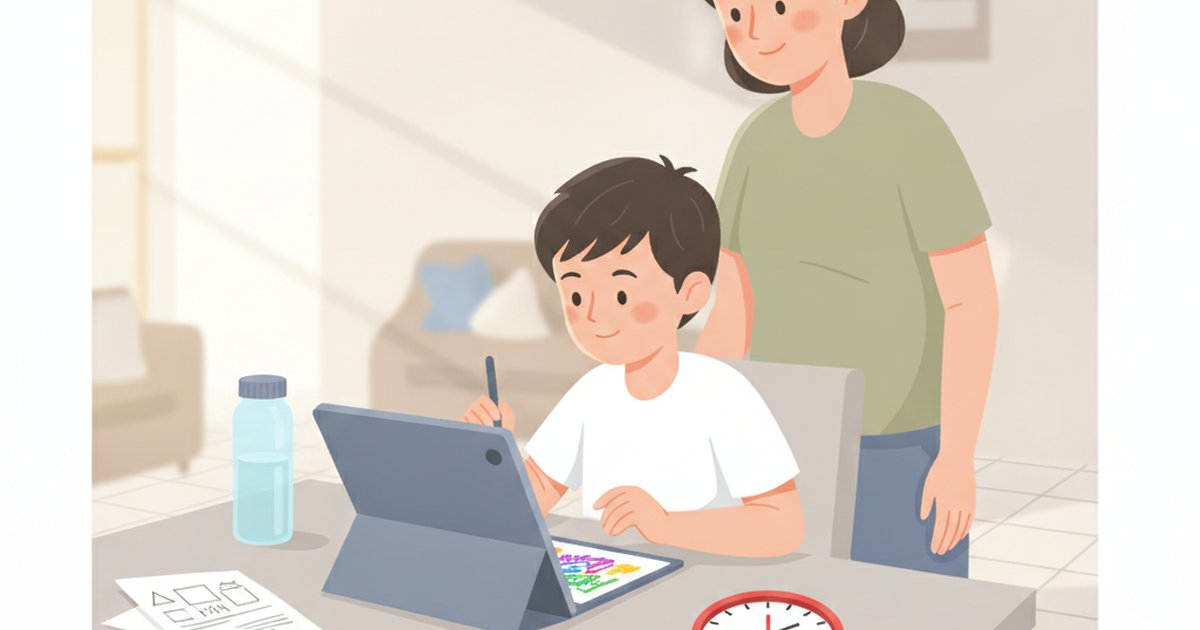
The best fix isn’t less screen — it’s a different kind of screen. Multimodal tools change the equation. When your P3 daughter can speak her answer or draw her Math working on a canvas instead of typing paragraphs she’s too young to type, the screen stops being a passive rectangle and becomes a workbench.
That matters practically. Many parents hold off on AI tutors precisely because typing distracts young kids from the actual learning. Voice and handwriting recognition sidestep that — the child thinks in their native mode, and the “screen time” is really just thinking-out-loud time.
Three habits that keep it healthy:
- Sit within earshot the first week. Listen to whether the AI is teaching or spoon-feeding. You’ll know within two sessions.
- Use a physical timer, not the app’s own. A kitchen timer on the table beats trusting a self-report.
- Check the parent dashboard, not the minute count. What concepts is your child stuck on? What did they retry three times? That tells you if the screen time is working — the very feedback loop that tuition centres leave you guessing about until exam results land.
The Bottom Line
Stop counting minutes and start judging quality. A screen that asks your child to think, speak, and solve is an ally. One that hands over answers is just a fancier distraction — and MOE’s own free SLS leans on guiding questions for exactly this reason.
Set sane ceilings, protect sleep, sit close at first, and pick a tutor built to teach rather than to tell. Do that, and the screen stops being the enemy. It becomes the thing that finally gets your kid unstuck.