The way Singapore PSLE Science marks open-ended answers is unforgiving. Miss one keyword in a four-mark explanation and you get one mark out of four. Get the science right but phrase it wrong — same outcome.
Which is why the marking, not the science, is what most P5–P6 kids actually struggle with. It’s also why AI tutors have become a real option here — if you use them properly.
Why PSLE Science Open-Ended Is Hard to Mark
A typical P6 question:
“State why the metal cup feels colder than the wooden cup at room temperature.”
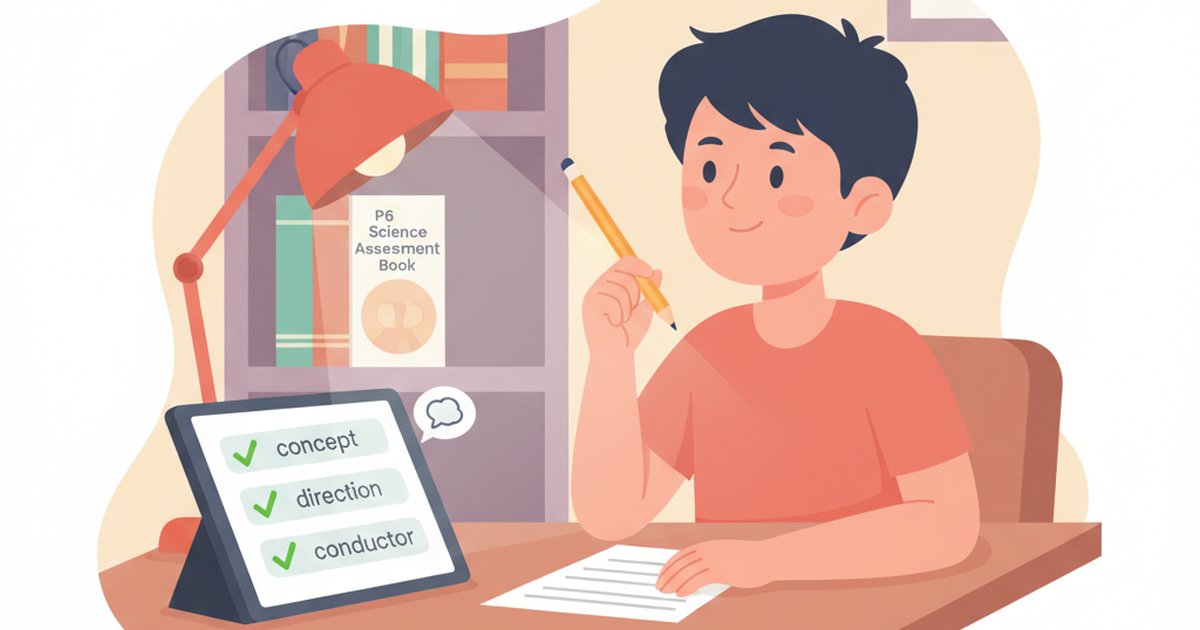
An acceptable answer must contain:
- Heat transfer concept (heat moves from a hotter object to a cooler one)
- Direction (heat from your hand → cup)
- Conductor language (metal is a better conductor of heat than wood)
Three keywords. Miss one — drop a mark. Get the order wrong — drop a mark. Use “hot” instead of “heat” — sometimes drop a mark, depending on the marker.
Parents trying to mark this at home spend 20 minutes per question second-guessing the scheme. It’s the most common Sunday-night frustration in PSLE-prep households.
How a Human Tutor Marks
A good Science tutor:
- Reads the answer
- Highlights missing keywords against the model scheme
- Asks the kid to revise that specific section, not the whole thing
- Re-marks after revision
Total tutor effort per question: 3–5 minutes. That’s why Science centres charge S$320/month — real marking takes real time.
How AI Marks It
Done right, AI runs the same loop in under 30 seconds. The kid writes (typed, voice-dictated, or photo of handwritten paper), and the AI:
- Compares the answer against the standard PSLE marking-scheme structure
- Identifies missing keywords by category (concept, direction, conductor)
- Asks the kid to add the missing piece — Socratically, not by giving the answer
- Re-marks the revised version
This is genuinely useful. It also costs almost nothing per question, which means a P6 kid can drill 30 open-ended questions a week instead of the 4–6 a tuition tutor can realistically mark.
For a kid heading into prelims, that’s the difference between “sometimes get it right” and “reliably get it right.”
Where AI Marking Fails
Three places to watch:
1. Strict mark schemes the AI doesn’t know. Some topics have Singapore-specific phrasing the AI may not have seen. Sense-check the first few questions in any new topic against an actual MOE-aligned marking scheme before trusting the AI’s score.
2. Almost-right phrasing. A human tutor knows when “the metal pulls heat from the hand” is acceptable in 2026; AI may flag it as wrong. Cross-check occasionally with a teacher friend or your school’s marking guide.
3. Diagrams and labelled drawings. Most AI is shaky at marking biology and physical-system diagrams. For diagram questions, paper + a teacher still wins.
A Realistic Weekly Drill
| Day | Drill | Time |
|---|---|---|
| Mon | 5 short open-ended questions, AI-marked + revised | 25 min |
| Wed | 1 long structured question (4–6 marks), kid self-marks then AI-checks | 25 min |
| Fri | Spot-the-keyword drill — show wrong answer, AI asks kid what’s missing | 15 min |
Total: 65 minutes a week. Less than a single Science-centre session, with 5–8× the question volume and far tighter feedback loops.
The Honest Verdict
For PSLE Science open-ended marking, AI is now genuinely competitive with a tuition-centre tutor — especially for the high-volume, “drill the keywords in” phase that runs from Term 2 through prelims.
It is not a full replacement. Concept-teaching, particularly for tricky topics like heat transfer or electrical circuits, still benefits from a human teacher who can demo with their hands. But once your child understands the concept, AI marking is the single highest-leverage way to convert understanding into actual PSLE marks.
That’s the bridge most parents miss. It’s also where one decent AI subscription can replace the cost of a full Science-centre subject without losing the result.