
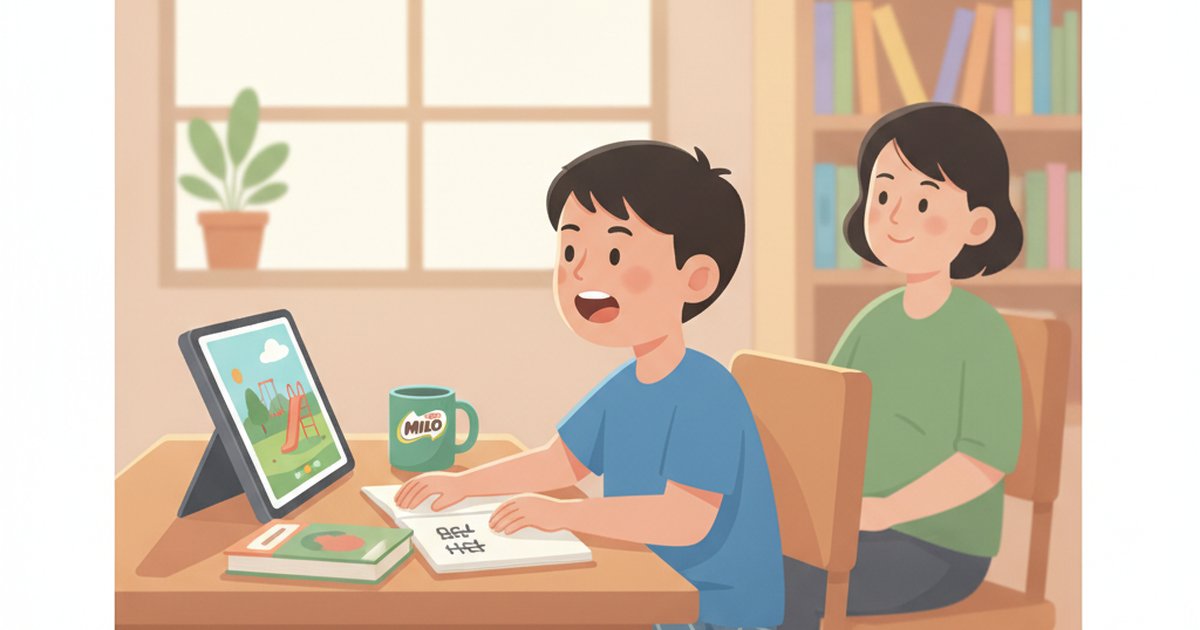
The written papers get all the worksheets. The oral component gets a panicked week of practice in the living room — usually with a parent who isn’t sure how to mark it either.
That’s the gap. Reading aloud, stimulus-based conversation, and Mother Tongue 口试 are the parts of PSLE you cannot rehearse with a screenshot-and-type app. Your child has to open their mouth. And most AI tutors on the market reward typing, not speaking — one reason a parent of a P3 reported holding off on a subject because her daughter struggled to type long answers. Oral practice needs voice. Here’s how to do it without a tuition slot.
Why oral is the hardest part to practise at home
Oral is a live, spoken performance. Reading fluency, pronunciation, expression, and the ability to talk back to a picture stimulus — none of it shows up in an assessment book. So parents fall into two traps: skipping it entirely until the week before, or drilling it themselves and second-guessing every correction.
For English-speaking households, Mother Tongue oral is the sharpest pain. If 华文 is barely spoken at home, where does a child rehearse conversation? This is exactly where incumbents fall short — one major platform built its Chinese on the old syllabus instead of 欢乐伙伴, so it didn’t match what schools teach. Voice practice has been an afterthought across the board.
What AI voice practice actually does for oral
A voice-native tutor lets your child practise out loud, on demand, as many times as they want — no judgment, no booked slot. For the reading-aloud component, they read the passage and the AI listens, then coaches pace and expression. For stimulus-based conversation, the AI shows a picture and asks follow-up questions the way an examiner would, nudging a one-word reply into a full answer.
The point isn’t to hand over a model answer. It’s Socratic: prompt, listen, prompt again. Research on AI tutoring warns that systems which just give answers breed “metacognitive laziness” and hurt retention. Oral is the same — a child who only hears the perfect response never builds the muscle to produce their own.
All three languages, the same way
English oral, and Mother Tongue 口试 for Chinese, Malay, and Tamil, all run on the same voice loop:
- Reading aloud — fluency, pronunciation, and tone, with instant replay so your child hears themselves.
- Conversation — picture or topic prompts, examiner-style follow-ups, encouragement to elaborate.
- 听写 prep — for Chinese, spoken practice that pairs with character writing on a drawing canvas, not a keyboard.
For Malay and Tamil families especially, who often have the fewest resources, having a patient voice partner at home is the difference between rehearsing and just hoping.
Where to start before you pay anyone
Use what’s free first. MOE’s Singapore Student Learning Space is built into the curriculum and worth knowing, though its coverage is narrow and it isn’t built for after-school oral drilling. Parent forums like KiasuParents are full of real PSLE oral passages and stimulus pictures you can practise with tonight.
Then, if you want a voice partner that works across all three languages, look for the things that actually matter for oral: voice input that’s central, not bolted on; the correct 欢乐伙伴 syllabus for Chinese; and monthly billing you can cancel anytime — no annual lock-in. There are tools now from around S$39 a month for one child, or S$59 for up to three, that do this without trapping you in a year-long contract.
Make it a routine, not a panic
The single biggest oral win isn’t a tool — it’s ten minutes a day, out loud, starting in P5 rather than the week before the exam. Voice AI just removes the friction: no scheduling, no parent who has to be the examiner every evening, no waiting for a tuition slot.
Pay attention, give it four weeks, and your child walks into the oral having actually spoken — in all three languages they need — instead of having only read about it.