
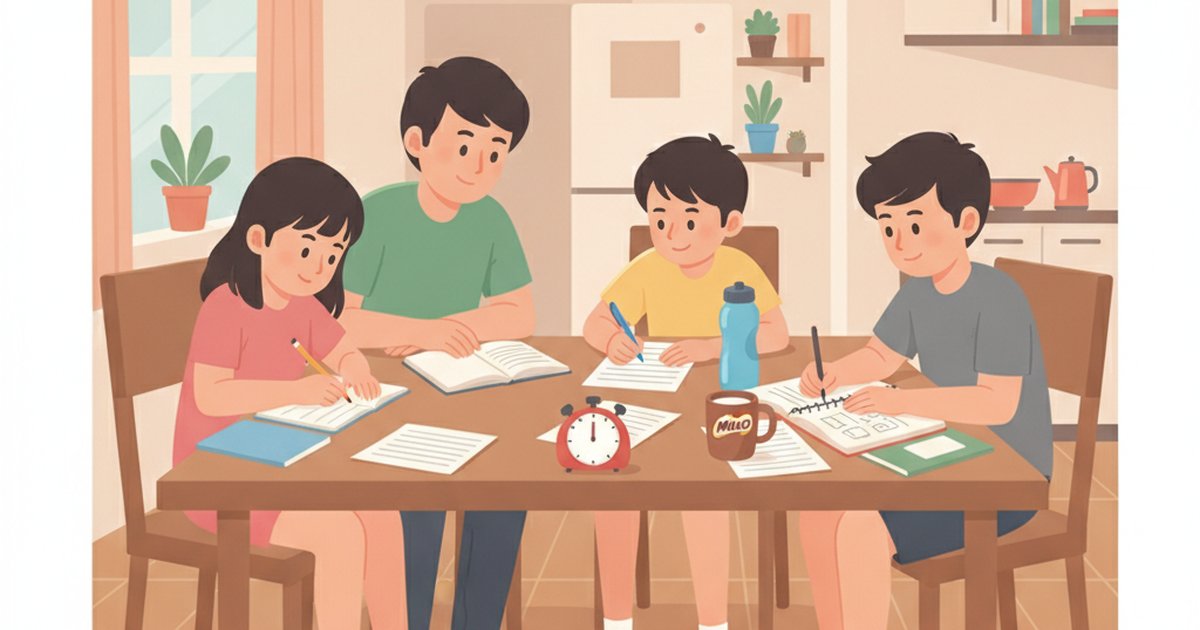
Three kids, three syllabuses, one HDB dining table. Your P2 needs you beside her for everything, your P5 has problem sums you barely remember how to solve, and your Sec 2 claims he’s “revising” behind a closed door. You can’t be three tutors at once — and ferrying three children to three different tuition centres is a part-time job.
There’s a simpler pattern: one shared study hour, same table, each child on level-appropriate work while you circulate. Here’s how to run it without it collapsing by minute twelve.
Why does one shared hour beat three separate schedules?
Singapore parents spent S$1.8 billion on private tuition in 2023, and a big chunk of that money buys logistics: fixed slots, travel, waiting. Fixed schedules clash with CCAs and family time — if a child is tired that evening, the slot is simply wasted.
A family study hour flips that. Zero travel, same time daily, and — the underrated part — younger kids copy older ones. When your Sec 2 sits down without drama, your P2 learns this is simply what the family does at 7.30pm. You’re building a norm, not policing three individuals.
How do you set up the table so it actually works?
Three rules before anyone opens a book:
- Everything out before the timer starts. Water, pencils, the exact worksheet. Every “I need to get something” is an escape hatch.
- One visible timer, one hour, no phones on the table. The Sec 2’s phone lives in another room. Yes, really.
- Fixed seats. P2 beside you, P5 across, Sec 2 at the end — youngest within arm’s reach, oldest with a sense of independence.
What should each child actually be doing?
- P2 — your anchor child. Two 20-minute blocks with a wiggle break between. Reading aloud, spelling and 听写, simple sums. Skip typed work: parents report even P3 kids struggle to type long answers, and the typing distracts from the learning. Oral and handwritten win at this age.
- P5 — one task, one finish line. Ten problem sums, one comprehension, one science topic — something that visibly ends. Vague “go and revise” instructions die at this age. For Math, MOE’s free Student Learning Space offers adaptive learning paths covering P5 Math — a solid zero-cost source of structured practice.
- Sec 2 — autonomy for evidence. Before the hour, he names the one thing he’ll finish tonight. At the end, he shows it. That’s the whole deal.
What do you do while they work?
Circulate — don’t teach. Your P2 gets most of your chair time; for the older two, you’re quality control, not content expert.
The honest problem: P5 problem sums and Sec 2 work will outrun most parents, and marking open-ended answers — where every step has to be read — is the chore parents hate most. Feedback that arrives a week late is feedback kids stop trusting.
This is where an AI tutor earns a seat at the table. LearnBuddy covers P1 to JC2 across subjects, so one S$59/month Family plan (up to three child profiles) serves all three kids: the P2 talks and draws instead of typing, the P5 gets her working checked on the spot, the Sec 2 gets hints rather than answers. Tuition centres, for comparison, run S$180–S$600 a month — for one subject, one child.
What about the nights it falls apart?
It will, some nights. Recovery rules:
- A bad night is a skipped night, not a failed system. Resume tomorrow, same time.
- Never extend the hour as punishment. The timer ending on time is what makes kids trust it.
- If one child derails repeatedly, shrink their task — not the routine.
Kids stacked with too many classes report chronic stress and lack of sleep; one predictable hour at home is the antidote, not another burden. Threads on KiasuParents keep landing on the same discovery: consistency beats intensity.
The bottom line
One table, one hour, three levels: anchor the P2, give the P5 a finish line, trade the Sec 2 autonomy for evidence, and let tools handle the marking you can’t. Run it five nights a week for a month before judging it. Most “my kids can’t study together” stories are routine failures wearing kid-failure costumes.