Here’s the problem nobody markets to you: almost every AI tutor in Singapore is built for the PSLE child. The screenshots, the past-year-paper libraries, the “adaptive engines” — all of it over-indexes on Primary 5–6, because that’s where parent money is most desperate.
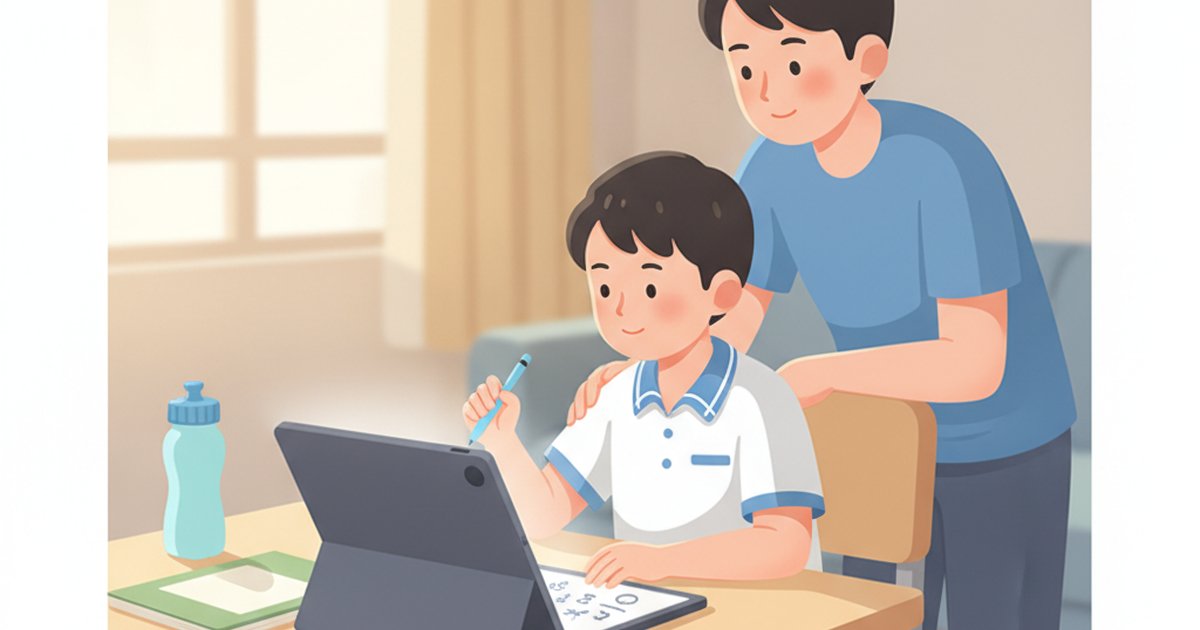
Your P2 or P3 kid is a different animal. He thinks faster than he types. He can’t punch out a long synthesis sentence, and Math working can’t be typed at all. So the tools that wow Sec 2 parents quietly fail your seven-year-old. Pick wrong and you’ll pay monthly for something your child avoids by February.
Why typing is the dealbreaker nobody mentions
One Singapore mum held off subscribing her P3 daughter to Science specifically because the typing demands distracted from learning. That’s the whole story of lower primary in one sentence.
Most platforms — Tutorly at S$49/month, much of Geniebook — are text-typing-dominant. A textbox suits a teenager. For a P1–P4 child, every minute spent hunting for keys is a minute not learning fractions or 华文.
So your first filter is brutal and simple: can the child use it without typing? Look for voice input, a drawing canvas, and image upload. If the answer is “type your question here,” it’s not a lower-primary tool, whatever the homepage says.
Teaching vs. answer-vending
The second filter is whether the tool teaches or just hands over answers.
This matters more for young kids. Academic research is loud here: standard ChatGPT-style tutoring can hinder retention, and a December 2024 study warned of “metacognitive laziness.” For a child still building foundations, a tool that spits answers builds dependency, not skill. Parents feel this instinctively — the fear that AI becomes a shortcut that undermines the basics.
Ask: does it ask guiding questions, or does it solve the sum for you? MOE’s own free Student Learning Space bakes this in — its LEA feature asks guiding questions rather than answering outright. Any paid tool you choose should at least match that posture, ideally with a mode that refuses answers and only nudges.
Don’t pay PSLE prices for a P2 child
The third filter is commercials, because lower primary is a long game and lock-in punishes you.
Geniebook runs around S$1,850/year per subject — roughly S$154/month — on an annual contract that auto-renews, with a 30-day refund window and a suspension cap of just 60 days. That’s a lot to commit when your child is six and you’re still learning what works. Parents on KiasuParents trade horror stories about exactly these terms.
Compare the flat-fee players: Tutorly and Klara sit at S$49/month with no annual lock-in. The principle for P1–P4: pay monthly, cancel anytime, never sign a year away for a child whose needs will change by next term.
Get Mother Tongue right early
The gap that bites English-speaking households hardest is Chinese. Geniebook’s Chinese was built on the old syllabus, not 欢乐伙伴 — so it didn’t match what’s taught in school today.
For lower primary that’s a real miss. P1–P4 is exactly when 听写 and character handwriting habits form. A tool that handles pinyin, character-stroke recognition, and oral practice by voice is worth more now than any PSLE paper bank. If your household speaks mostly English at home, treat Mother Tongue support as a primary filter, not a nice-to-have.
The shortlist test
Run any candidate through six checks before you pay:
- Voice and drawing input — no typing required
- A Socratic mode that guides instead of answering
- 欢乐伙伴-aligned Chinese, with handwriting and oral practice
- A parent dashboard showing concepts stuck on, not just worksheets done
- Monthly billing, cancel anytime, no annual lock-in
- A free trial so your child tries it before any commitment
Six out of six — start the trial and watch your child use it for a real week. Anything less, keep looking. This is the wedge LearnBuddy is built for: multimodal-first, P1–JC2, S$39 Solo or S$59 Family for up to three kids, cancel anytime — the opposite of a year-long contract.
The best AI tutor for a lower primary child isn’t the one with the most PSLE papers. It’s the one your seven-year-old can actually talk to, draw on, and learn from — without you finding out at exam time whether it worked.