
Marking is the part of PSLE prep nobody enjoys. Parents hate going through assessment books — especially Math problem sums and Science open-ended questions where every step has to be read. Tuition centres take a week. Geniebook’s human teachers turn around open-ended questions in three days. By the time the red pen arrives, your child has forgotten what they were even thinking.
Done right, AI marking fixes this. Here are five things it does better than a human — and one thing it doesn’t.
1. Feedback in Seconds, Not Days
The loudest complaint about paid tuition is the broken feedback loop. Geniebook’s own marketing admits it: parents pay monthly and only find out if it’s working when exam results arrive months later.
A good AI marker reads the working the moment your child submits it. Wrong step on line three of a ratio problem? The hint surfaces before line four is written. That’s the difference between learning and forgetting.
2. It Marks the Working, Not Just the Answer
PSLE Math problem sums aren’t graded on the final number — they’re graded on method marks. A human marker rushing through 80 books at 10pm misses partial credit. They tick or cross.
AI built for the MOE Math syllabus reads each line of working. It tells you which step broke the chain — unit conversion, model drawing, or an arithmetic slip. That’s the diagnostic parents have been doing by hand for years.
3. The Rubric Never Gets Tired
By the 40th Science open-ended answer, a human marker is exhausted. The 41st child gets a different mark for the same answer. Anyone who’s compared marking between two centres knows this.
AI applies the same rubric on paper one and paper one hundred. Singapore’s MOE Student Learning Space is built on the same principle — consistent automated feedback at scale. Your child’s mark this Tuesday matches your child’s mark next Tuesday.
4. It Tells the Parent What’s Actually Weak
A worksheet that comes back “32/40” tells you nothing. A worksheet that comes back “32/40 — recurring loss on fractions of remainder, struggling with passive-voice synthesis” tells you exactly what to do on Saturday morning.
This is the dashboard tuition centres rarely provide. The KiasuParents forum is full of parents asking “my kid scores well in mock papers but flunks the real thing — why?” AI marking aggregated across 30 sessions answers that. A weekly tuition slot can’t.
5. It Never Gives Up at Midnight
Your P6 finishes a Math paper at 9.45pm. The centre marker has gone home. The tutor replies on Wednesday. By then your child has stopped caring.
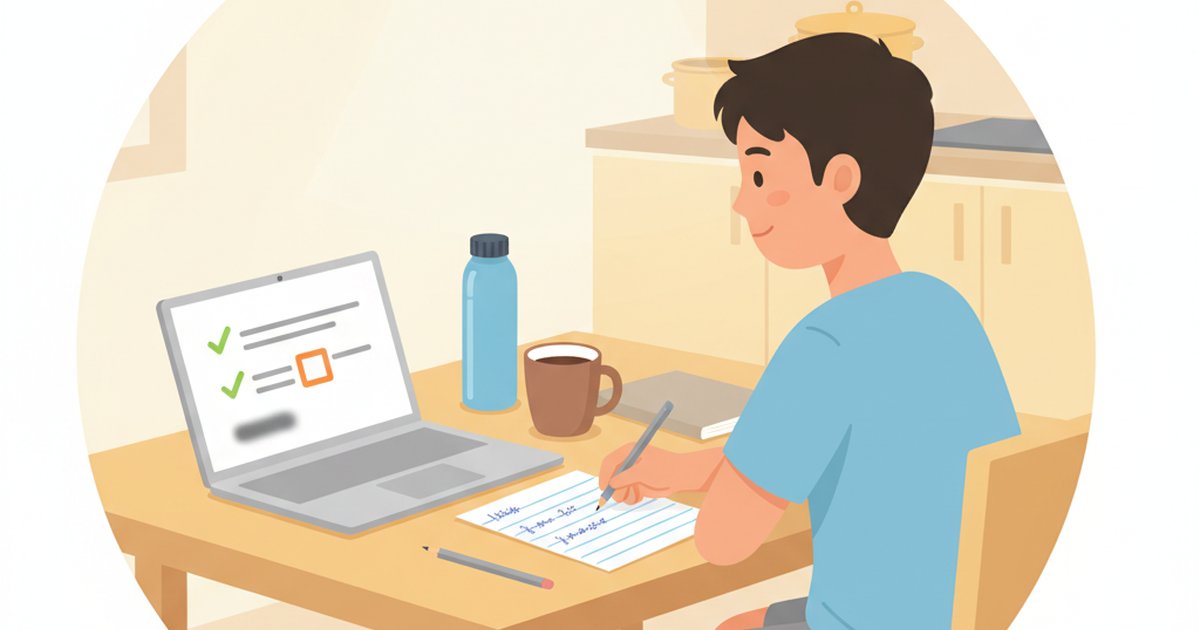
AI marks at 10pm on a Sunday in the September break. No three-day queue, no after-school waiting room, no CCA clash. The marking lives where the studying lives — in your kitchen, on your laptop, at the moment of confusion.
What AI Marking Won’t Do (Be Honest)
AI marking can hallucinate — get a fact subtly wrong, mismark an unusual phrasing. This is real, and parents are right to worry. A good AI marker shows its reasoning so you can sanity-check it. A bad one hides behind a green tick.
It also won’t replace the human conversation your child sometimes needs — the “why does this matter, when will I use this” conversation that AI is bad at. A human tutor or parent still owns that.
The point isn’t to replace the human marker. The point is to stop your child from waiting three days to find out they misread the question.
The Bottom Line
Tuition centres charge S$180 to S$600 a month per subject, plus the wait. One Tampines family spent over S$5,000 in a single year without seeing the grade jump. The marking lag is a big reason why.
Instant, consistent, step-aware, dashboard-friendly AI marking closes the loop. It won’t sit the PSLE for your child. It will make sure every mistake gets caught the same day it’s made — which is, finally, how learning is supposed to work.